I think almost everyone in Malaysia who keeps fish started with a Betta.
I remember as a kid, seeing them in small glass jars at the local pet shop, or sometimes even sold in plastic bags at the pasar malam (night market). They seemed like such simple pets—no filter, no air pump needed. Just put them on a desk and feed them.
But as I’ve spent more time quietly observing them, I’ve realized these little fish are actually quite complex. They have a lot of history and a very big personality packed into a small body.
Here are the things I’ve learned about the modern Betta fish.
1. History & Origins (The Rice Paddy Fighter)
The Betta fish we see in shops today looks very different from its ancestors.
Originally, they came from the shallow, muddy rice paddies and slow-moving streams of Southeast Asia (mostly Thailand, Vietnam, and around our region too).
In the past, people bred them for their aggression—hence the name “Siamese Fighting Fish.” They were strong, short-finned, and fierce.
Over the last few decades, however, breeders have focused on beauty instead of fighting. They bred them to have longer fins and brighter colors. The fish we keep today are like the “show dogs” of the fish world—beautiful, but perhaps a bit more delicate than their wild cousins.
2. The Body: Built for Survival
The most interesting thing about the Betta’s body is how it survives in dirty, shallow water where other fish would die.
- The Labyrinth Organ: Betta fish have a special skill: they can breathe atmospheric air. They have a special organ inside their head called the Labyrinth Organ. This allows them to gulp air at the surface.
- My thought on this: This organ is the reason they can survive in tiny jars or cups. But I’ve learned that just because they can survive there, doesn’t mean they are happy there. It’s a survival tool for droughts, not a permanent lifestyle preference.
- My thought on this: This organ is the reason they can survive in tiny jars or cups. But I’ve learned that just because they can survive there, doesn’t mean they are happy there. It’s a survival tool for droughts, not a permanent lifestyle preference.
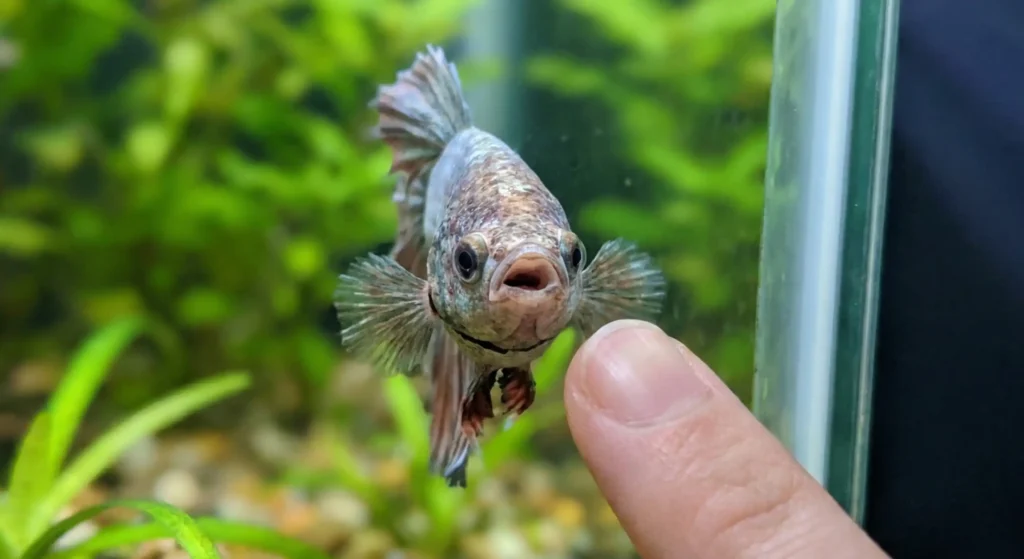
- The Upturned Mouth: Like the Arowana, their mouth points upwards, designed for snatching food (like mosquito larvae) from the water’s surface.
3. Varieties & Colors (The Modern Art)
When I walk into a Betta shop now, it can be overwhelming. There are so many types. I usually categorize them in my head by two things: Fin Shape and Color Pattern.
- By Fin Shape:
- Plakat (PK): Short fins. These look closest to the wild type. I personally prefer these because they are more active and swim easily. They don’t get tired dragging heavy fins around.
- Halfmoon (HM): The tail opens up to a full 180-degree semi-circle. They are stunning to look at, but I notice they are more prone to tearing their delicate fins.
- Crowntail (CT): The fins have spiky tips, like a crown.
- Plakat (PK): Short fins. These look closest to the wild type. I personally prefer these because they are more active and swim easily. They don’t get tired dragging heavy fins around.
- By Color Pattern:
- Solid: Just one bright color (Red, Blue, White).
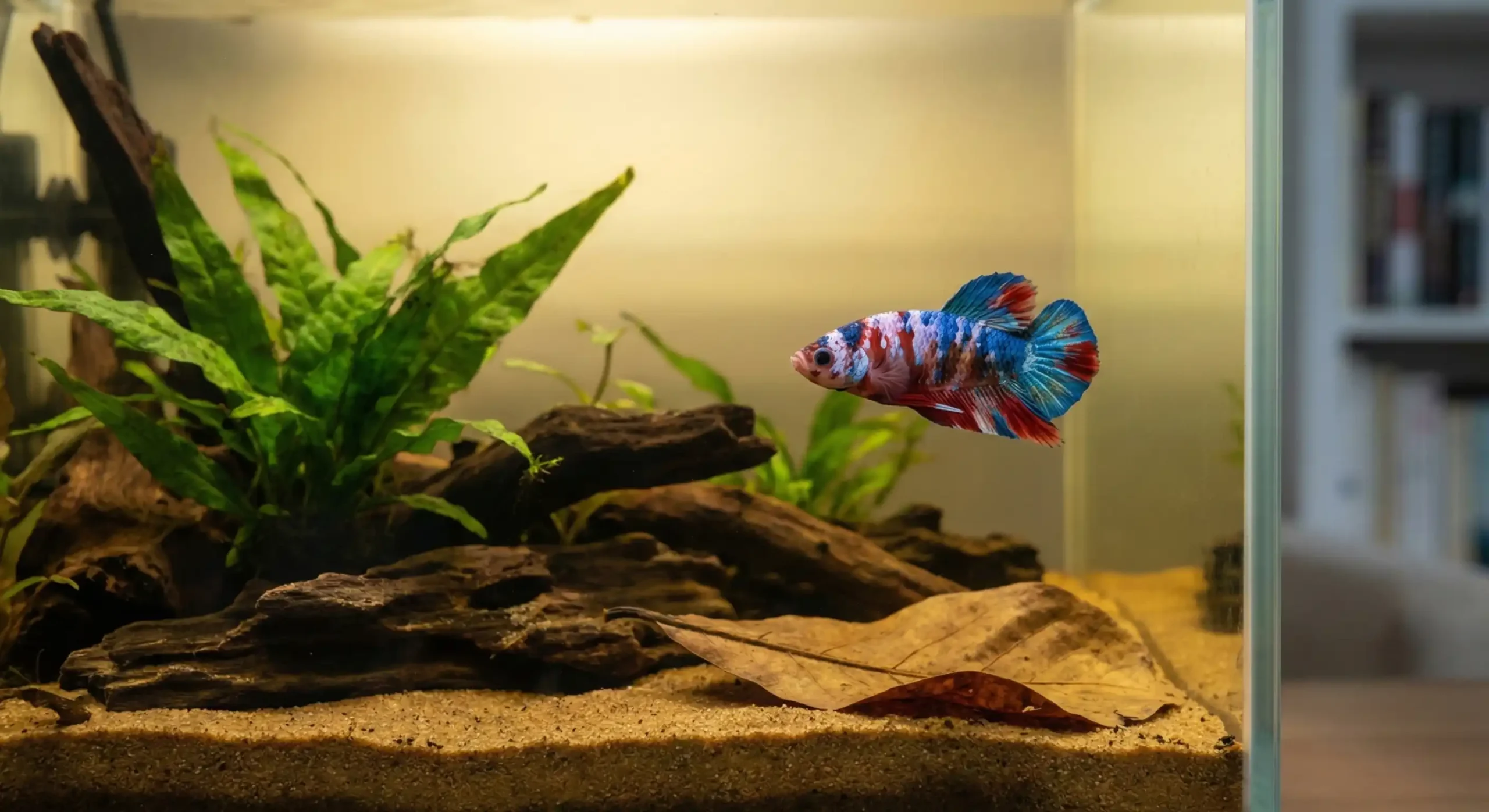
- Koi / Galaxy: This is the trendy style right now. They look like miniature Koi fish, often with shiny, metallic scales that look like stars (galaxy). No two fish look exactly the same.
- Solid: Just one bright color (Red, Blue, White).
4. Personality (The “Angryboi”)
For a fish that sits quietly in a tank, they have a lot of character.
- Interactive: I find them to be very intelligent. After a week or so, my Betta usually recognizes me when I walk up to the tank. He knows I am the “food bringer” and will wiggle excitedly at the front glass.
- Territorial: They are solitary. You cannot keep two males together—they will fight to the death.
- The “Flare”: When they see another male (or even their own reflection in a mirror), they push their gill covers out to look bigger. It’s impressive to watch, but I try not to let them do it too often as it consumes a lot of energy.
5. The Environment They Need
This is where I see the most debate online. Because of that Labyrinth organ I mentioned, people think they love tiny spaces.
- Tank Size: While they survive in a cup, I have noticed they become much more active and colorful when given a bit of space. I prefer a tank that is at least 5 liters (about a 1-foot standard tank).
- Water Flow: They hate strong currents. In the wild, their water is almost still. If you use a filter, it needs to be a very gentle sponge filter. If the current is too strong, they get stressed trying to swim against it.
- The Magic Leaf: Living in Malaysia, we are lucky to have easy access to Ketapang Leaves (Indian Almond Leaves). I always put a piece of this dried leaf in my Betta tank. It turns the water slightly yellowish (tannins), which mimics their natural environment and has mild antibacterial properties. They seem much calmer with it.
6. Diet
They are carnivores (meat-eaters).
- In the wild: They eat insects and larvae.
- In my tank: I feed them high-quality Betta pellets (like Hikari Betta Bio-Gold). Sometimes as a treat, I give them frozen bloodworms.
- My challenge: The hardest part is not overfeeding them. Their stomachs are only as big as their eyeball. They always act hungry, and it’s very tempting to just give them “one more pellet,” but this causes bloating.
The Betta is often called a “starter fish,” but I think that sells them short. They are interactive, beautiful, and full of personality. Even if I only have space for a small desk tank, having a Betta fish there makes the space feel alive.