Here in Malaysia, when we say “Arowana,” we almost always mean the majestic Golden or Red Asian Arowana. It’s the pride of our local rivers.
But as I dug deeper into the hobby, I realized that the Arowana family is actually much bigger than just our local species. There are cousins swimming in the Amazon jungle, the billabongs of Australia, and even the muddy rivers of Africa.
It’s fascinating to see how the same “Dragon” blueprint evolved differently across the planet. Here are my notes on the different types of Arowana found around the world.
1. The South American Giants (Amazon River)
These are the ones usually found in the “budget” section of the aquarium shop, but they grow to be the longest of them all.
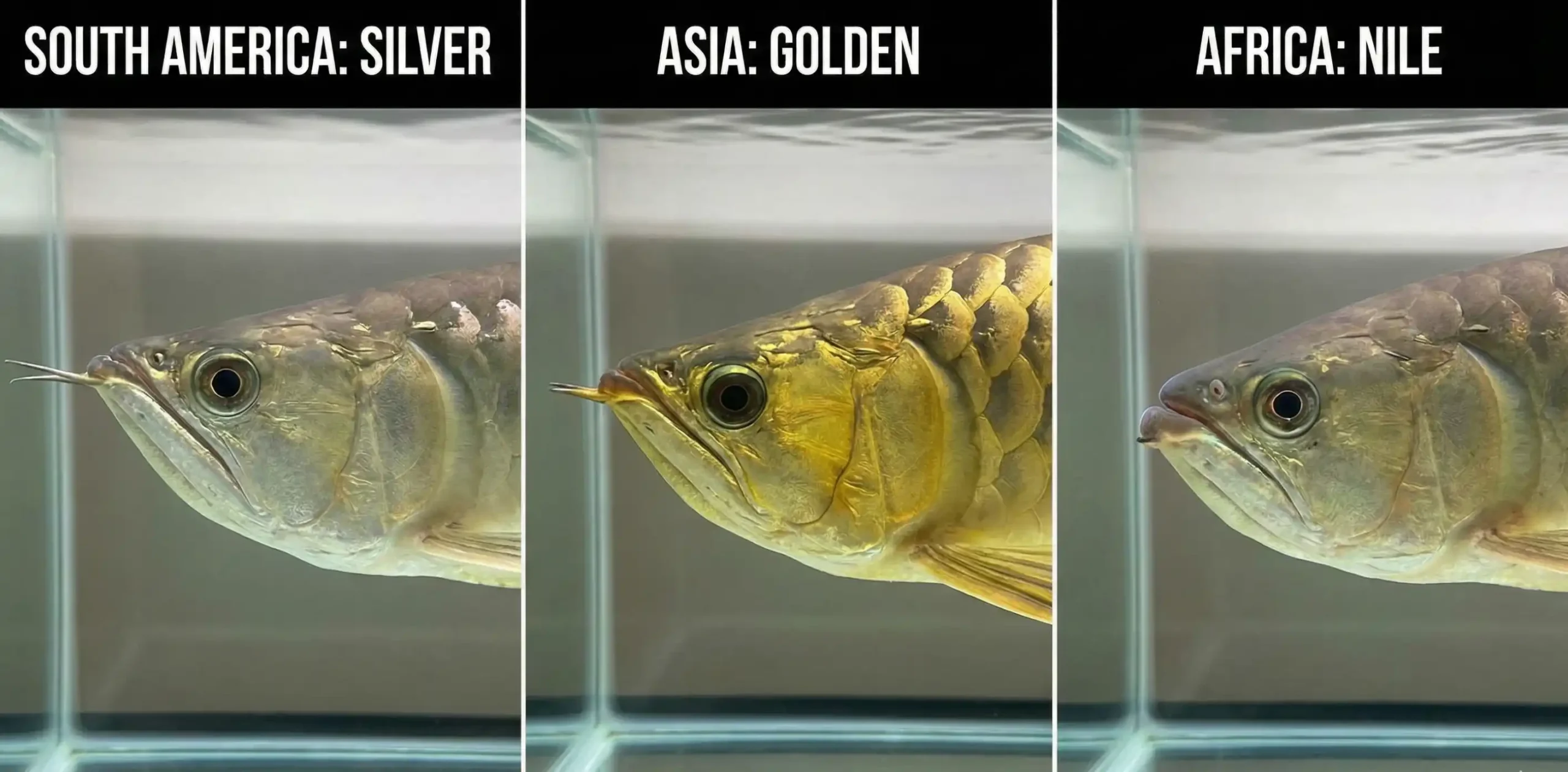
- The Silver Arowana (Osteoglossum bicirrhosum)
- The Look: Long, ribbon-like body with huge, silver scales. They can grow massive—up to 4 feet (120cm) in the wild.
- My Observation: They seem to have a more flexible body than our Asian ones. However, I’ve read they are prone to a condition called Drop Eye, where one eye permanently looks down because of fatty deposits or looking for food on the bottom.
- Temperament: Generally less aggressive than the Asian varieties, but they will eat anything that fits in their mouth.
- The Look: Long, ribbon-like body with huge, silver scales. They can grow massive—up to 4 feet (120cm) in the wild.
- The Black Arowana (Osteoglossum ferreirai)
- The Look: As babies, they are stunningly beautiful with black bodies and yellow stripes. As they grow older, the black fades into a dark grey/purple steel color with red fins.
- Note: They are known to be more sensitive to water parameters (pH shock) than the Silvers. A bit more fragile, but beautiful.
- The Look: As babies, they are stunningly beautiful with black bodies and yellow stripes. As they grow older, the black fades into a dark grey/purple steel color with red fins.
2. The Australian Fighters
Down in Australia, the Arowanas evolved to be tougher and fiercer. They look very similar to our Asian ones but have distinct differences.
- The Jardini Arowana (Scleropages jardinii)
- The Look: Often called the “Northern Barramundi.” They have a metallic body with distinct pinkish-orange crescent patterns on their scales.
- Personality: From what I’ve heard from other hobbyists, this is the “gangster” of the family. They are famously intolerant of tank mates. While an Asian Arowana might tolerate a Stingray, a Jardini often wants to be the only living thing in the tank.
- The Look: Often called the “Northern Barramundi.” They have a metallic body with distinct pinkish-orange crescent patterns on their scales.
- The Leichhardt Arowana (Scleropages leichardti)
- The Look: Very similar to the Jardini but with a straighter back profile and smaller red spots on the fins.
- Rarity: Much harder to find in Malaysian shops compared to the Jardini. They are strictly surface dwellers and rarely go to the bottom of the tank.
- The Look: Very similar to the Jardini but with a straighter back profile and smaller red spots on the fins.
3. The African Oddball
This is the “cousin” that looks completely different from the rest of the family.
- The African Arowana (Heterotis niloticus)
- The Look: It has a rounded nose (no sharp jaw) and almost looks like a prehistoric carp. It doesn’t have the “Dragon” look we are used to.
- The Difference: Unlike the other predators, this fish is a Filter Feeder in the wild. It sifts through the sand/mud to eat plankton and small organisms. Because of this, they are generally peaceful and shy. They are quite rare in the hobby because they are hard to feed.
- The Look: It has a rounded nose (no sharp jaw) and almost looks like a prehistoric carp. It doesn’t have the “Dragon” look we are used to.
4. The Asian Family (Returning Home)
We know the Gold and Red, but there are two other unique members in our own region.
- The Green Arowana (Scleropages formosus)
- The Look: The “Wild Type.” It has pale grey-green scales.
- Note: It is often the cheapest of the Asian varieties, but I find their natural, subtle beauty very calming. They don’t scream for attention like a Super Red does.
- The Look: The “Wild Type.” It has pale grey-green scales.
- The Batik Arowana (Scleropages inscriptus)
- The Look: Discovered fairly recently in Myanmar. It has intricate wavy patterns all over its body that look like Batik cloth tattoos.
- Status: Extremely rare and expensive collector’s item.
- The Look: Discovered fairly recently in Myanmar. It has intricate wavy patterns all over its body that look like Batik cloth tattoos.
It is humbling to realize that while we obsess over the “perfect” Gold Crossback here in Penang, somewhere in the Amazon, a Silver Arowana is jumping 5 feet out of the water to catch a beetle.
They are all Dragons, just wearing different armor.