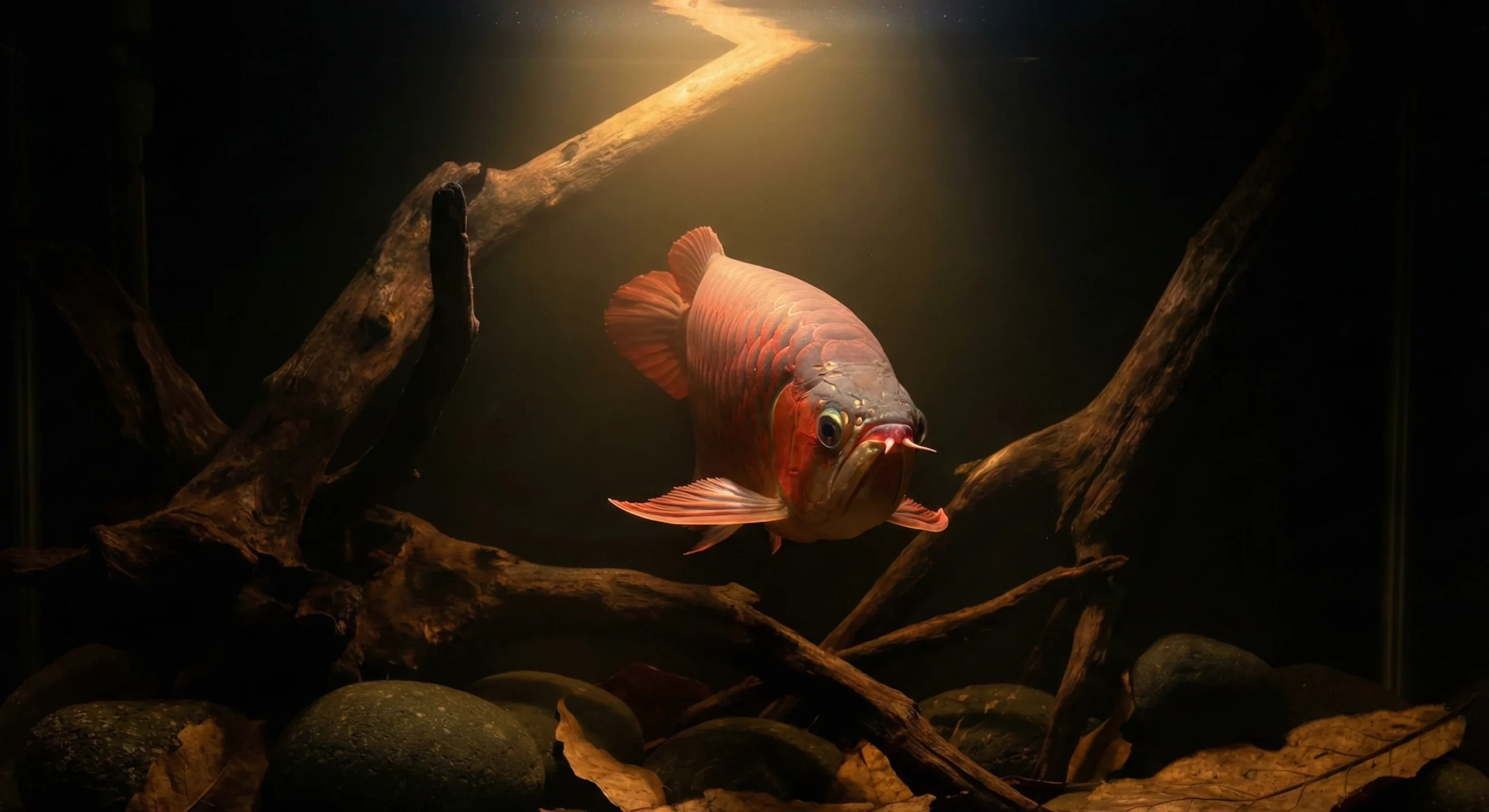
I remember the first time I stood in front of a large tank containing an Arowana. It didn’t swim frantically like the other fish. It just hovered there, staring back at me with those large, intelligent eyes.
To me, the Arowana (or Ikan Kelisa as we call it here in Malaysia) feels less like a pet and more like an ancient spirit in the room. I’m not an expert on these majestic creatures, but I have spent a lot of time reading about them and observing them.
Here are the details I’ve gathered about the “Dragon Fish.”
1. History & Origins
The Arowana is essentially a living dinosaur. They belong to a family of fish called Osteoglossidae, which literally means “Bony Tongue.” Scientists say they have existed since the Jurassic period—over 100 million years ago.
While we see them as lucky charms today, in the past, they were actually caught as food in the rivers of Southeast Asia and the Amazon. It wasn’t until the late 20th century that people began to appreciate them for their beauty and resemblance to the mythical Chinese Dragon.
2. The Body & Appearance
What makes them so special is their unique anatomy. They don’t look like modern fish.
- The Mouth: It opens like a drawbridge (upwards). This is because in the wild, they hunt near the surface, snatching insects or birds from hanging branches.
- The Scales: They have huge, metallic scales arranged in neat rows. This is why people compare them to armor or coins.
- The Barbels: On their chin, they have two small “whiskers.” These are sensory organs used to sense vibrations in the water, adding to that “Dragon” look.
3. Varieties & Colors
In Malaysia, we usually see three main categories. Each has a very different “vibe.”
- The Asian Arowana (Scleropages formosus): This is the prized one. They are native to our region (like Bukit Merah). They come in stunning Gold (Crossback/Highback) and Red (Super Red). They are shorter and stockier than the others.
- Important Note: These are a CITES Protected Species. This means they are endangered in the wild. When you buy one, it MUST come with a microchip implanted in its body and a matching birth certificate from the farm. Never buy one without it.
- Important Note: These are a CITES Protected Species. This means they are endangered in the wild. When you buy one, it MUST come with a microchip implanted in its body and a matching birth certificate from the farm. Never buy one without it.
- The Silver Arowana (Osteoglossum bicirrhosum): These come from the Amazon river. They are long, slender, and swim like a ribbon. They are usually much cheaper, but they can grow extremely long (up to 3-4 feet).
- The Australian Arowana (Jardini): They look similar to the Asian variety but usually have a more patterned scale design (like pearls). They are known to be a bit fiercer.
4. Personality
From what I’ve observed, the Arowana is a fish with a lot of character.
- Intelligent: Many owners feel that their Arowana recognizes them. They will often come to the front of the tank when the “feeder” walks into the room but might hide from strangers.
- The Jumper: This is their instinct. In the wild, they jump to catch prey. In a tank, this can be dangerous. I’ve heard too many sad stories of owners forgetting to latch the lid, only to find their beautiful fish on the floor the next morning.
5. The Environment They Need
Since I prefer a simple setup, I found that Arowanas actually appreciate simplicity too. They need space more than they need decoration.
- Tank Size: This is the big hurdle. A baby can start in a 3-foot tank, but an adult really needs a 5-foot or 6-foot tank to turn around comfortably.
- Water Condition: They seem to prefer “Soft” to “Neutral” water (pH 6.0 – 7.0). In Malaysia, our tap water is usually okay after using anti-chlorine, but keeping the water clean is key.
- Tank Mates: They are predators. I notice they do best alone (solitary). If kept with others, the tankmates need to be big and tough (like Stingrays or Tinfoil Barbs) so they don’t get eaten.
6. Diet
In the wild, they are carnivores. In captivity, I see people feeding them a mix of things:
- Market Prawns: A favorite for many.
- Pellets: Floating sticks (like Hikari Food Sticks) are great because they provide balanced nutrition without the mess.
- Insects: Crickets or mealworms (a nice treat).
- A quiet note: Some people feed live goldfish or frogs. Personally, I avoid this because of the risk of introducing diseases from the feeder fish.
The Arowana is a beautiful commitment. It’s not a fish you buy on impulse. But for those who have the space and the patience, having a “Dragon” swimming silently in your living room is a very peaceful experience.