We all think we know the Betta fish. It’s the angry, colorful fish that builds a bubble nest and fights anything that moves.
But recently, I started reading about the wider Betta genus, and I realized that the fish we keep (Betta splendens) is just the tip of the iceberg. It’s like knowing only the “Golden Retriever” and not realizing there are Wolves, Foxes, and Coyotes in the same family.
There are over 73 recognized species of Betta in Southeast Asia. Some are giants, some are peaceful, and some don’t even build nests.
Here is what I found in the deeper end of the Betta world.
1. The “Mouthbrooders” (Fathers who don’t build nests)
This was the biggest shock to me. We are taught that male Bettas build bubble nests at the surface to hold eggs. But that is only true for the “Splendens” complex.
Many wild Bettas, especially those from faster-flowing streams in Borneo and Sumatra, are Paternal Mouthbrooders.
- How it works: instead of making a bubble nest (which would wash away in a fast stream), the male catches the eggs and holds them in his mouth for weeks until they hatch.
- The Sacrifice: During this time, the father cannot eat. He starves himself to protect his children.
- Species to look up: Betta channoides and Betta albimarginata.
2. The “Holy Grail”: Betta Macrostoma
If Betta splendens is the common villager, then Betta macrostoma is the Emperor.
- The Name: It literally means “Big Mouth.”
- The Origin: They are found in the rainforests of Brunei and Sarawak.
- Why it’s special: They are huge (up to 10-11cm), brilliantly colored with patterns that look like tribal tattoos, and they are mouthbrooders.
- The Challenge: They are incredibly difficult to keep. They require very cool water (below 26°C) and extremely pure water. In the past, they were so protected by the Sultan of Brunei that it was illegal to export them. Now, captive-bred ones are available, but they cost hundreds of Ringgit.
3. The “Blackwater” Specialists
We often complain about our tank pH. But some wild Bettas live in extreme environments that would kill a normal fish.
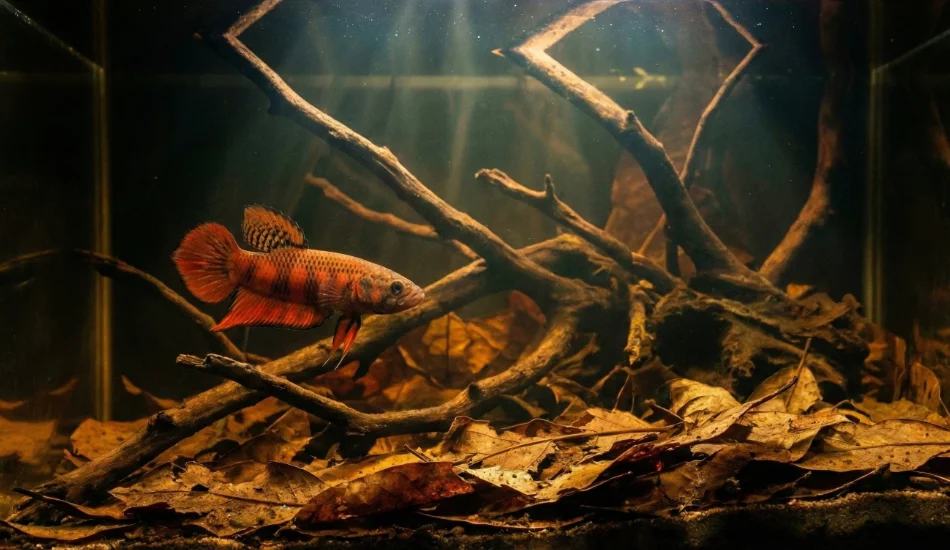
- The Environment: They live in Peat Swamps where the water is dark brown (like tea) from decaying leaves.
- The Acid: The pH in these swamps can drop as low as pH 3.0 or 4.0. To put that in perspective, that is almost as acidic as vinegar or orange juice.
- Why this matters: It teaches us that “clean, clear water” isn’t always what a fish wants. These species (like Betta coccina) thrive in dark, acidic, tannin-stained water where bacteria cannot survive.
4. The “Alien” Hybrid Controversy
You might have seen metallic, robotic-looking Bettas on Instagram called “Alien Bettas.”
- What they are: These are not a natural species. They are a man-made hybrid, created by crossing Betta splendens with wild cousins like Betta mahachaiensis and Betta smaragdina.
- The Debate: They are stunningly beautiful, with scales that cover their entire face (mask). But some purists worry that mixing these bloodlines messes up the genetics of the pure wild species. It’s a conflict between “Art” and “Nature.”
5. The Sad Reality (Conservation)
This is the heavy part of my research. While we buy Bettas in plastic cups, their wild cousins are disappearing. The peat swamps of Malaysia and Indonesia are being drained for palm oil plantations. Species like Betta persephone (a tiny, beautiful black betta) are now listed as Critically Endangered.
Learning this made me look at my little tank differently. The Betta isn’t just a “starter pet.” It is a survivor from the ancient rainforests of Southeast Asia.
If you ever feel bored with the common colorful Betta, maybe try keeping a “Wild Type” pair. Watching a father release fry from his mouth is a magic trick that beats any bubble nest.