You buy 5 beautiful Guppies. You have a filter. You have plants. You feed them premium pellets.
But within a week, their fins look clamped shut. They stay in one spot, shaking and wiggling but not moving forward. Then, they die.
You test the water: Ammonia is 0. Nitrite is 0. You are confused. “My water is clean! Why are they dying?”
The answer is invisible. It’s not about how clean your water is; it’s about how hard it is.
Guppies are not like Tetras or Bettas. They hate soft water. Here is why the “Mineral Secret” is the key to keeping Guppies alive in Malaysia.
1. The “Shimmy” Warning
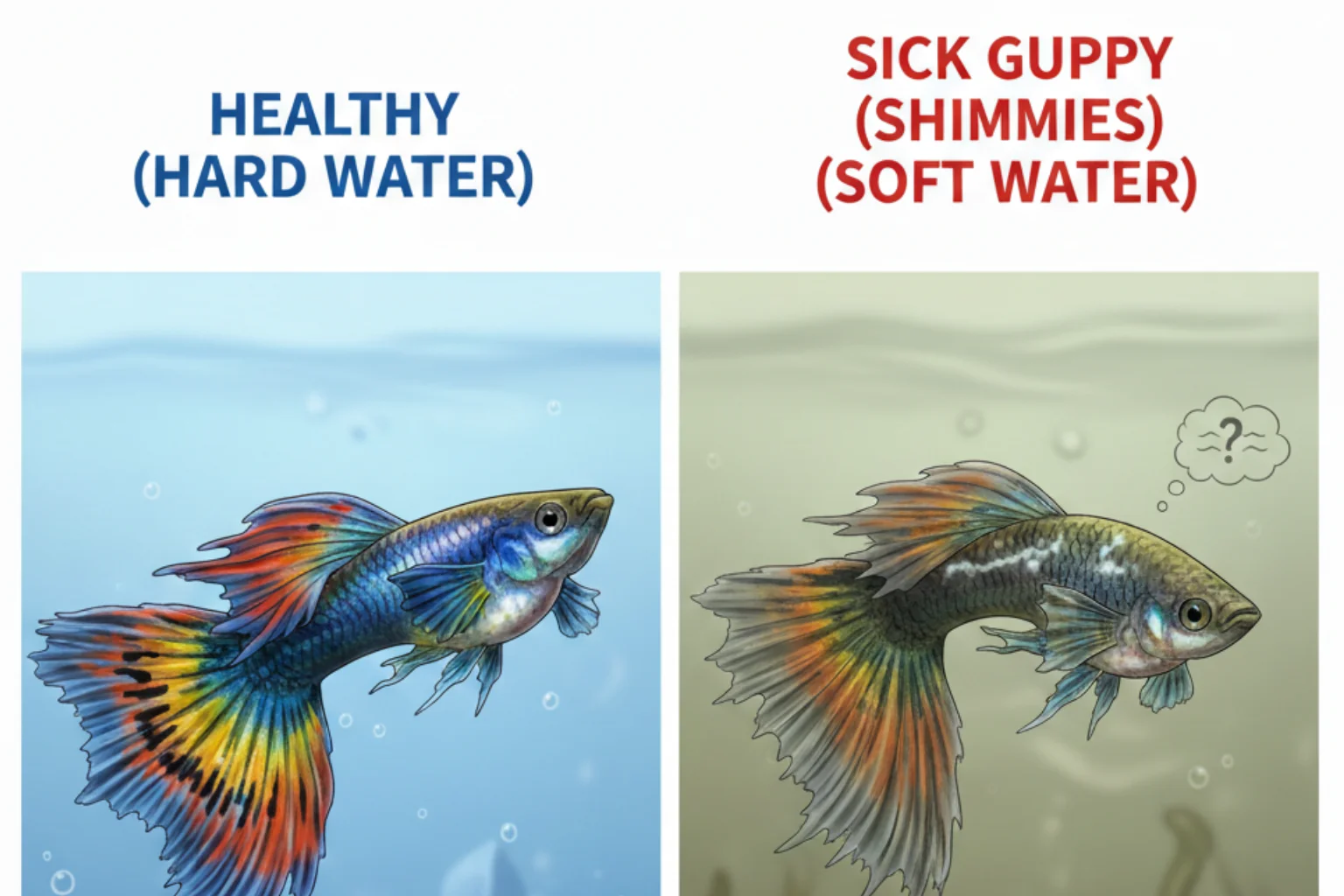
Before a Guppy dies from soft water, it usually gives you a warning sign called “The Shimmies.”
- What it looks like: The fish swims in place, wiggling its body efficiently, like it is shivering from the cold. Its fins are usually clamped tight against its body.
- What it means: The fish’s muscles are failing. Guppies need calcium and magnesium in the water to control their internal pressure (osmoregulation). If the water is too pure (soft), their bodies have to work overtime just to stay alive, and they eventually collapse from exhaustion.
2. The Malaysian Water Problem
In many parts of Malaysia, our tap water is naturally soft. Furthermore, many hobbyists make the mistake of using Diamond/Coway/Cuckoo filtered water for their aquarium.
- The Mistake: Drinking filters remove heavy metals and chlorine, which is good. But they also remove minerals.
- The Result: You are putting your Guppies in “dead water.” It is too pure for them. Unlike Neon Tetras (which love soft water), Guppies originate from mineral-rich streams in Central America.
3. The RM5 Solution: Crushed Coral
You do not need to buy expensive “pH Up” chemicals or “Guppy Salts” every week.
You just need a bag of Crushed Coral (Karang Hancur).
This is a cheap, natural gravel made from old coral bones. It is pure calcium carbonate.
- How to use it: Buy a mesh media bag. Put a handful of Crushed Coral inside. Hide the bag inside your filter or in a corner of the tank.
- What it does: It slowly dissolves over time, releasing calcium and magnesium into the water. This raises the pH to a stable 7.5 – 8.0 and increases the GH (General Hardness).
- The Result: Your Guppies will perk up, spread their fins, and their colors will become brighter.
4. Other Key Parameters
Once you fix the hardness, the rest is easy:
- Temperature: Guppies are tropical fish. They thrive in 26°C – 30°C. Our Malaysian room temperature is perfect. You do not need a heater.
- Tank Size: Please, no bowls. Guppies are active swimmers.
- Minimum: 1 Foot Cube (5 Gallons) for a trio (1 Male, 2 Females).
- Ideal: 2 Foot Tank (15 Gallons) for a colony.
5. The “Cycle” Reminder
Even with perfect hard water, Ammonia will still kill them.
Guppies eat a lot and poop a lot.
- Filtration: You need a filter that disturbs the water surface (Oxygen) and houses bacteria. A Sponge Filter is the best choice for beginners because it won’t suck up the baby fry.
- Maintenance: Change 30% of the water once a week. When you add new water, try to use tap water treated with Anti-Chlorine, rather than highly filtered drinking water.
If you want to keep Tetras or Bettas, soft water is fine.
But if you want to keep Guppies, you need to think about Minerals.
Next time you are at the Local Fish Shop (LFS), pick up a small bag of Crushed Coral. It is the cheapest insurance policy you can buy for your “Million Fish” colony.