We call them monsters. We call them predators. But if you ever watch a pair of Channa with their babies, you will see a side of them that is softer than most other fish.
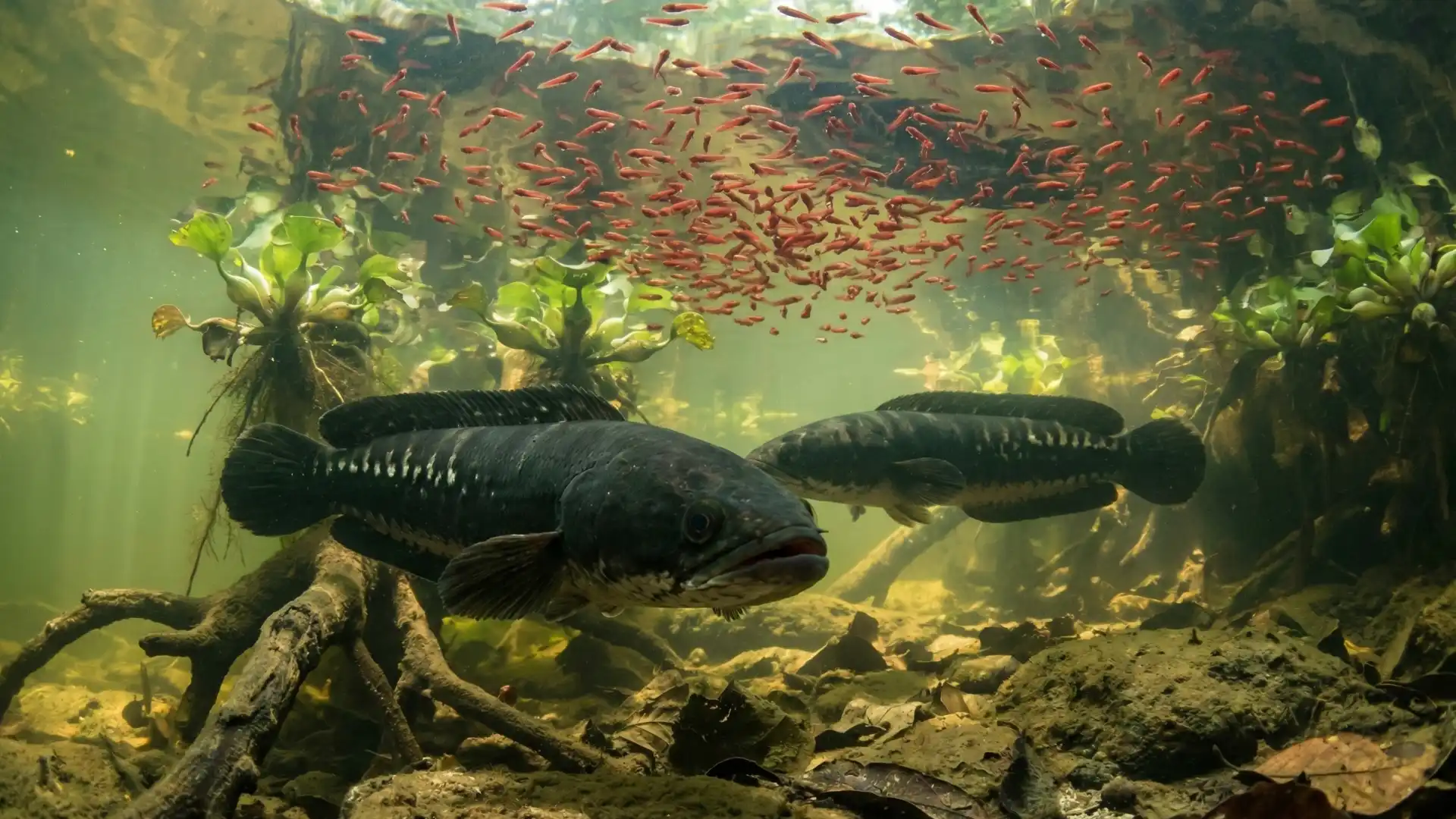
I remember fishing near a dam in Perak years ago and seeing a bright red ball of fry on the surface. My friend warned me, “Don’t cast there. The parents are underneath, and they are angry.”
He was right. The Channa is one of the most dedicated parents in the animal kingdom. They don’t just lay eggs and leave (like Goldfish). They stay, they guard, and sometimes, they even starve themselves to make sure their children survive.
Here are my notes on the two fascinating ways Snakeheads raise their families.
1. The Floating Fortress (Nest Builders)
The giant species found in our tropical waters (like the Toman and Maru) usually use this method.
- The Strategy: The parents clear a large circular area on the water surface among floating plants. They bite off stems and clear debris to create a “ring.”
- The Eggs: The female lays thousands of floating eggs inside this ring.
- The “Red Ball”: When the babies hatch, they gather in a tight, swirling ball. In the Toman species, the babies are bright red/orange. This signals to the parents exactly where the group is.
- The Guarding: This is where the legend comes from. Both the mother and father patrol beneath the ball. If anything comes near—a frog, another fish, or a fisherman’s lure—they attack with zero hesitation. They are fearless defenders.
2. The Silent Father (Mouthbrooders)
Just like the Betta fish we discussed, many Channa species (especially the smaller ones and the expensive types like Channa Barca and Channa Auranti) are Mouthbrooders.
- Why carry them? These species often come from rivers with stronger currents or cooler water. If they laid floating eggs, the river would wash them away. So, the father becomes the nest.
- The Process: After mating, the male scoops the fertilized eggs into his mouth.
- The Sacrifice: For weeks, the father holds the eggs in his cheeks. He cannot eat. He barely opens his mouth to breathe. He just hides in a cave, keeping the future generation safe inside him.
- The Release: One of the most magical sights in this hobby is seeing a male Channa finally “yawn” and release hundreds of tiny, fully formed babies into the world.
3. The “Feeder Egg” Phenomenon
This was the most shocking thing I learned during my research. Some Channa mothers (like Channa bleheri) go an extra step to feed their kids.
- The Problem: In the wild, baby fish often starve because they can’t find microscopic food.
- The Solution: The mother will lay thousands of infertile eggs (eggs with no babies inside) just for her children to eat.
- Nature’s Milk: Scientists call these Trophic Eggs. It’s almost like a mammal feeding milk to its young. The babies swarm the mother, eating these nutrient-packed eggs until they are big enough to hunt for themselves.
4. The Bonded Pair
If you want to breed Channa, you cannot just throw a male and female together like Guppies.
- They choose each other: Channa are monogamous (faithful). They form a strong pair bond.
- The Danger: If you force two adults together who don’t like each other, they will likely fight until one is dead.
- The Method: Most breeders buy a group of 5-6 babies and let them grow up together. As they mature, two will naturally pair off and start staying together in a corner. That is your bonded pair. You must remove the others immediately.
It is humbling to watch a creature that can snap a pencil in half with its jaws, be so gentle with its own tiny fry.
It reminds me that in nature, “fierce” and “loving” are not opposites. Sometimes, you have to be fierce because you are loving.