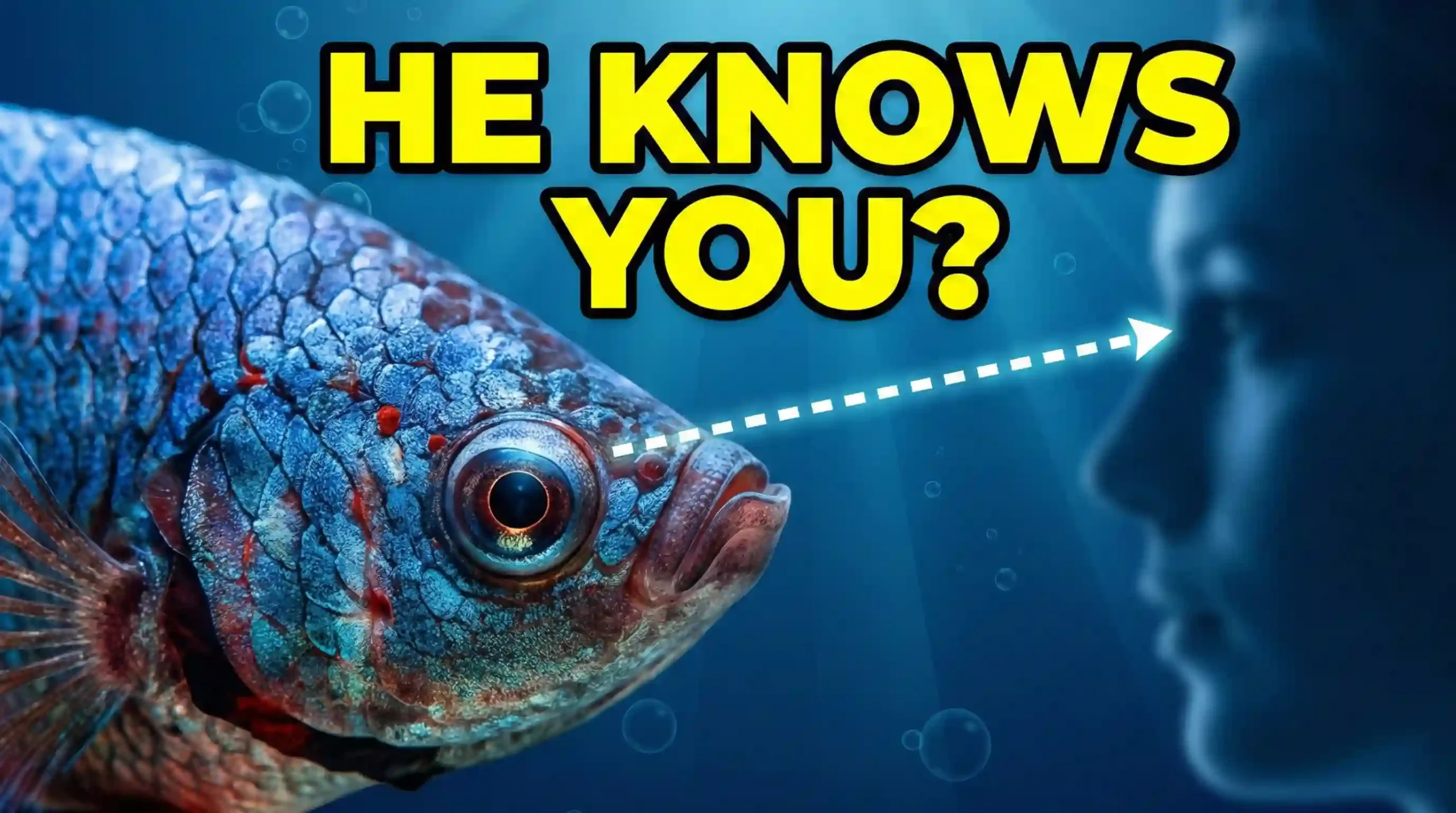
It is a feeling every Betta owner knows. You are sitting at your desk working. You feel eyes on you. You turn around, and there he is—your Betta, hovering motionless in the corner of the tank, staring right at your face.
He isn’t looking at the wall. He isn’t looking at the plant. He is looking at you.
Is it just hunger? Is it aggression? Or is there something more intelligent going on behind those tiny eyes?
The science suggests it is a mix of biology and genuine recognition. Here is what is actually happening when your fish locks eyes with you.
1. The Predator’s Vision (Binocular Focus)
First, we have to look at anatomy. Most prey fish (like Tetras) have eyes on the sides of their heads to scan for danger. They rarely focus on one spot.
Bettas are Predators.
While they use “Monocular Vision” (side eyes) to scan the environment, they have a unique ability to use “Binocular Vision” (using both eyes forward) when they lock onto a target.
- The Science: In the wild, they use this to calculate the exact distance of a mosquito larvae before striking.
- The Reality: When he stares at you, he is engaging his “Hunting Mode.” He is focusing his attention entirely on the biggest object in the room: You.
2. Scientific Proof: They Can Recognize Faces
You are not imagining it. He actually knows who you are.
A landmark study by the University of Oxford (using Archerfish, another visual predator similar to Bettas) proved that fish can distinguish between different human faces with 80% accuracy.
Bettas are highly intelligent. They learn patterns.
- The Stranger Test: Notice how your Betta reacts when a stranger walks up to the tank (usually hiding or flaring) vs. when you walk up (wiggling/begging).
- The Conclusion: To him, you are not just a shadow. You are the “Provider.”
3. The “Food God” Association (Pavlovian Response)
While we like to think it is pure love, a lot of it is Classical Conditioning.
- The Loop: You approach -> Lid opens -> Food appears.
- The Stare: He watches you because he is waiting for the specific micro-movements that indicate food is coming. If you raise your hand, he swims up. If you sit still, he waits. He is studying your behavior to predict his next meal.
4. Decoding the “Stare” (Body Language Table)
Not all stares mean the same thing. You have to look at his fins to understand the intent.
| Body Language | The Eye Contact | What It Means | How to Respond |
| The Wiggle | Staring + Swimming excitedly back and forth. | “Feed Me!” (Excitement) | Feed him (if it’s time), or play a finger-chase game. |
| The Flare | Staring + Gill covers puffed out + Fins spread wide. | “Back Off!” (Territorial) | You are too close or wearing a color he hates. Step back. |
| The Statue | Staring + Completely motionless + Fins relaxed. | “Curiosity” (Observation) | He is just watching “Human TV.” Feel free to stare back. |
| The Dart | Staring + Sudden hiding when you move. | “Fear” (Unsure) | You moved too fast. Approach slower next time. |
5. Why It Feels “Personal”
Unlike a Goldfish that swims endlessly in circles, a Betta has the capacity for Stillness.
He can hover in place using his pectoral fins like helicopter rotors. This ability to stop and hold eye contact is what creates the bond. It feels like a conversation.
The Bottom Line
Your Betta stares at you because to him, you are the most interesting (and important) thing in his world. You are the source of food, the changer of water, and the giant that lives outside the glass.
So, the next time you catch him watching you, don’t ignore him. Put your finger on the glass and say hello.