There’s a moment every guppy keeper goes through.
You stand in front of your tank, watching a fish you paid good money for—perfect tail, glowing colors, a clean “pure” strain—and you think: “Why does this one look like it’s about to die… but the ugly drain guppy I caught as a kid in the longkang never did?”
No fungus. No Ich. Water parameters look “fine.” And yet, the fancy one fades, clamps its fins, and quietly disappears.
This isn’t bad luck. And it’s not because you’re bad at fishkeeping. It’s genetics.
Beauty Is Not Free
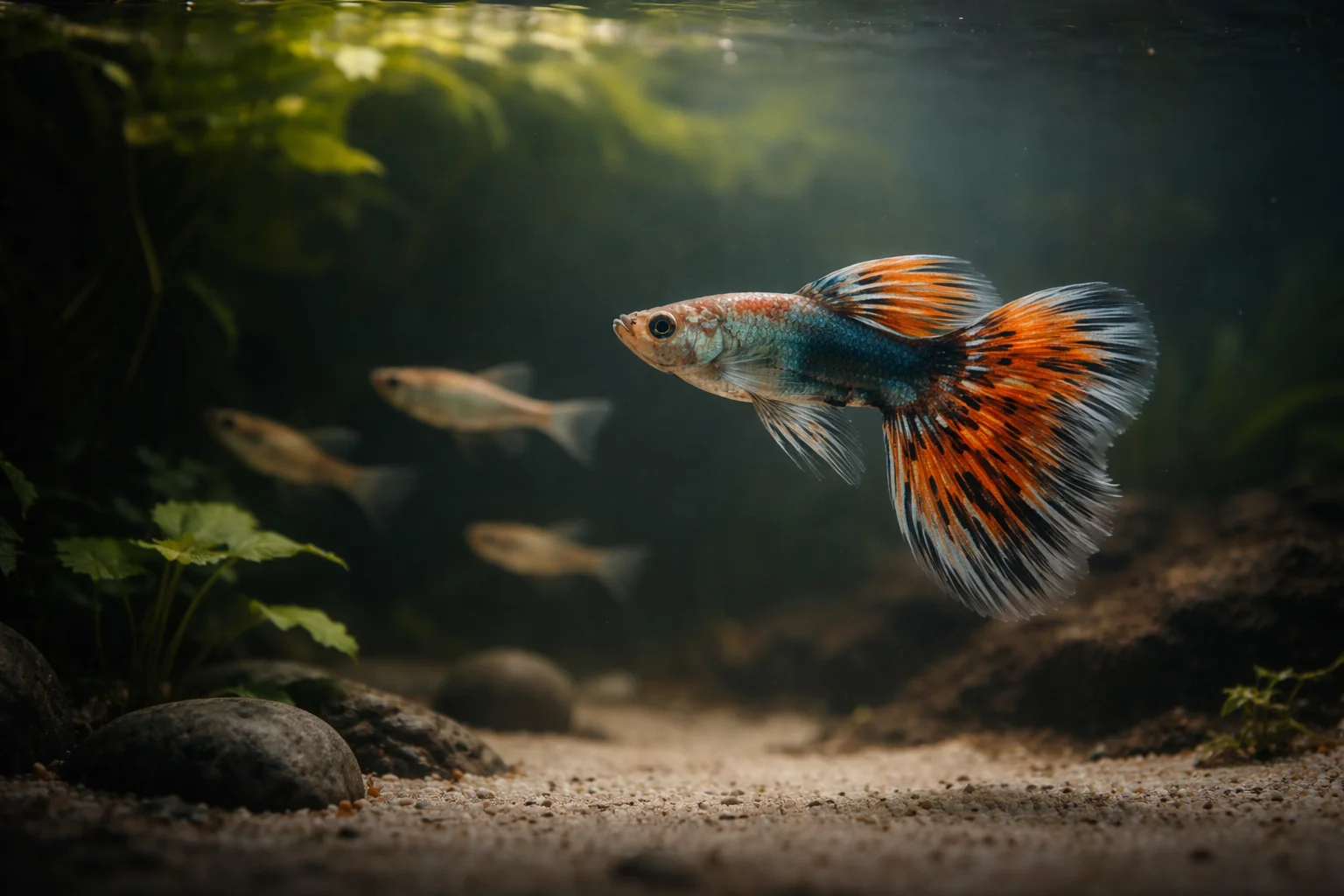
Fancy guppies are not “naturally” beautiful fish. They were made beautiful—slowly, deliberately, and repeatedly—by humans selecting the same traits over and over again.
Longer tails. Brighter reds. Solid gold bodies. Albino eyes. Every generation, breeders chose appearance over survival.
The problem is that genes don’t exist in isolation. When you select heavily for one trait, you also shrink the gene pool. Immune strength, organ efficiency, stress tolerance—these get “dragged along” for the ride. What you end up with is a fish that looks like jewelry but lives like it’s made of glass.
The “Longkang” Advantage
This is where the comparison becomes uncomfortable. Wild or feral guppies—the ones in Malaysian drains and ponds—are “ugly” by hobby standards. They have small tails and dull colors. No pedigree at all.
But they are genetic tanks. Why? Because nature is cruel in a very efficient way.
- Weak guppies don’t reproduce.
- Sick guppies don’t pass on genes.
- Only the toughest survive floods, heat, pollution, and predators.
No one is selecting for beauty in a drain. Only survival matters. So when a fancy guppy, bred in a clean glass box, meets real-world stress—fluctuating minerals, temperature swings, transport shock—it collapses. Quietly.
Inbreeding: The Silent Weakener
Most high-grade fancy guppies are “line-bred.” That means:
- Brother to sister.
- Father to daughter.
- Same bloodline, again and again.
This locks in the color and tail shape, but it also locks in the weakness. You might not see it on day one, but you see it later in the form of bent spines, short lifespans, and females dying after just a few births. It’s not a disease; it’s exhaustion at a genetic level.
Why Expensive Guppies Die Faster
This is the part people hate hearing: Expensive guppies often die faster because they are pushed further away from nature. They are optimized for a world that doesn’t exist in a normal home:
- Perfectly controlled water.
- Stable mineral levels.
- Low competition.
Your home tank—no matter how well-kept—is still “chaos” compared to a professional breeder’s setup. The more “perfect” the fish looks, the less margin for error it has. Beauty reduces tolerance.
This Is Not a Warning — It’s Context
This doesn’t mean fancy guppies are bad. It means our expectations need to change. A high-grade fancy guppy is not a “starter fish.” It’s closer to a Bonsai tree than a common houseplant.
It needs:
- Extra mineral support (GH/KH).
- Absolute stability.
- Lower stress environments.
Wild guppies forgive mistakes. Fancy guppies remember them.
Bottom Line
If you want a “set and forget” fish with zero stress, fancy guppies will likely disappoint you. But if you want living art and the satisfaction of keeping something delicate alive, then fancy guppies make sense.
Just don’t confuse beauty with strength. They are not weak because they were badly kept; they are weak because they were bred to be beautiful. That is the price of the prize.