It’s funny how things change. Growing up in Malaysia, the only time I saw a Snakehead (Ikan Toman or Haruan) was at the market, or maybe in a soup when someone had surgery. It was food.
But today, Channa keeping is one of the fastest-growing communities in our hobby. I see people paying RM10,000 for a rare Channa from India.
Why the change? I think it’s because we finally realized the truth: Channa are not just fish. They are underwater dogs. They beg for food, they recognize their owners, and they have eyes that actually look at you, not just past you.
1. History & The “Bad Reputation”
The Channa family comes mostly from Asia (Malaysia, Indonesia, India, China) and parts of Africa.
In the West (especially the USA), they are hated. They call them “Frankenfish” because they can crawl on land and destroy local ecosystems. In some states, it is illegal to own one.
But here in Asia, we respect them. We used to respect them for their healing properties (eating Haruan essence), but now we respect them for their beauty. The transition from “food fish” to “pet fish” has exploded with the discovery of colorful dwarf species from India.
2. The Body: The Ultimate Survivor
The name “Snakehead” is accurate.
- The Head: Flat and scaly, looking exactly like a python.
- The Breathing: Like Bettas, they are Obligate Air Breathers. This means they must come to the surface to breathe. If you hold a Channa underwater and don’t let it surface, it will actually drown.
- The “Crawl”: They can survive out of water for hours as long as they stay wet. I’ve read stories of Channa pushing the lid open, crawling across the living room floor, and surviving until the owner came home.
3. The Global Family (Types & Sizes)
This is where beginners get trapped. Channa range from “Cute & Small” to “River Monster.” You must know which one you are buying.
- The Local Giants (Malaysia/Indo)
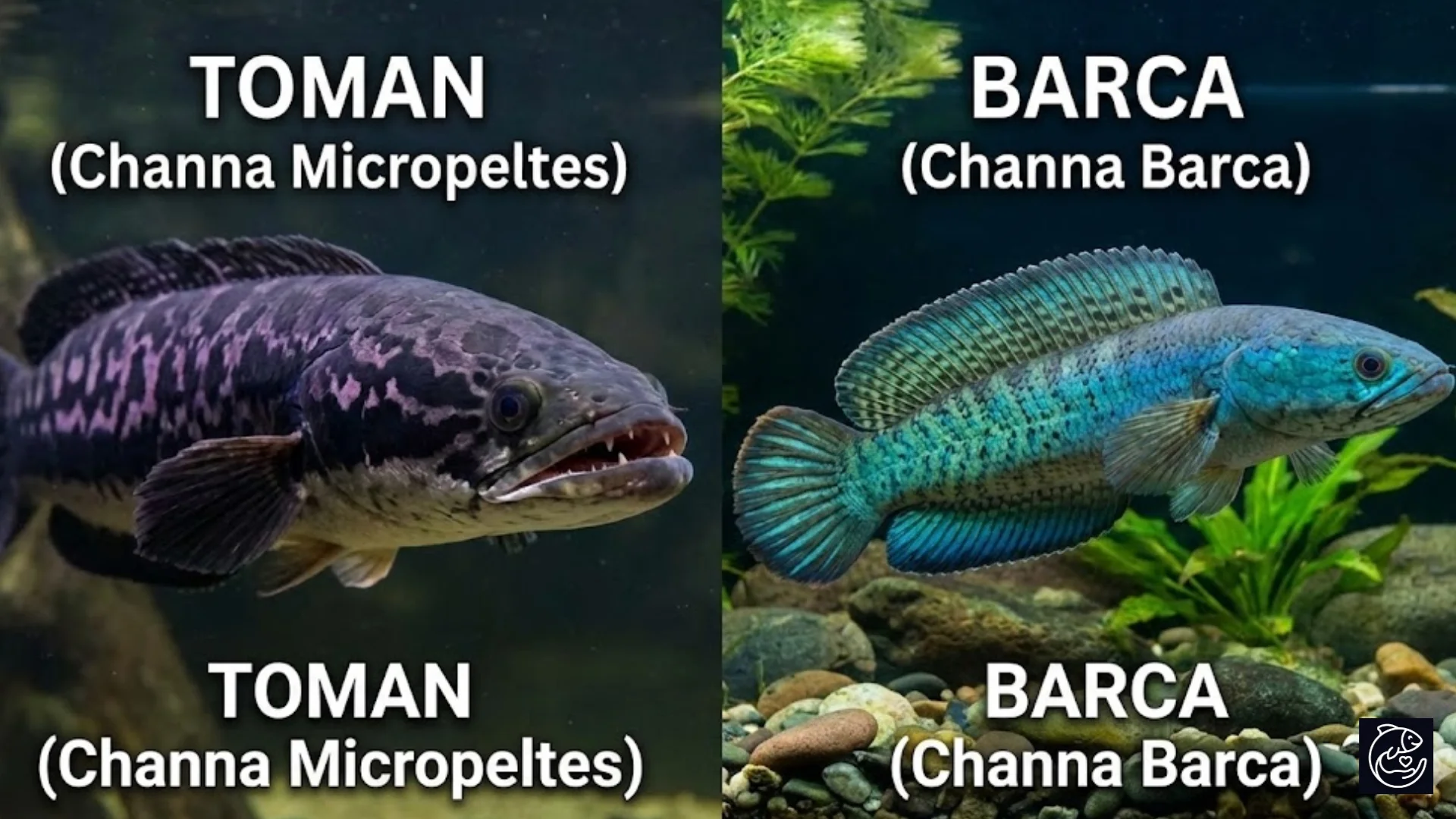
- Channa Micropeltes (Toman):
- Look: beautiful black and white stripes as babies (“Red Toman”), but they turn into purple/black beasts.
- Warning: These grow to 1 meter long. They are fierce. They have teeth that can cut your hand. Not for beginners unless you have a massive pond.
- Channa Marulioides (Channa Maru):
- Look: The “Emperor” of local Channa. They have distinct “flowers” (white spots) on their body.
- The Hobby: There are competitions just for Maru flowers, similar to Koi competitions.
- The Indian Jewels (The Expensive Ones)
- Channa Barca:
- The Holy Grail: This is the dream fish. They are blue/green with a massive dorsal fin.
- Price: A high-grade Barca can cost as much as a used Myvi.
- Channa Stewartii / Aurantimaculata:
- These are the popular mid-range choices. Beautiful colors, medium size (20-40cm).
- The Dwarf Snakeheads (For Small Tanks)
- Channa Andrao / Bleheri:
- These are perfect for 2-foot tanks. They stay small (10-15cm) and are incredibly colorful (Rainbow Snakeheads).
4. Personality
This is why people love them.
- Interactive: A Channa will follow your finger along the glass. They will dance when they see the food container.
- Aggressive: They are solitary. A Channa tank usually has one fish. If you put two together, one usually ends up dead unless they are a bonded breeding pair.
5. The Environment (A Crucial Warning)
I learned this the hard way: Temperature Matters.
- Tropical Channa: (Toman, Maru) love our Malaysian heat (28-30°C).
- Sub-Tropical Channa: (Many species from Northern India and China, like Channa Asiatica or Bleheri) actually prefer cooler water (22-26°C).
- My Mistake: If you keep a cool-water Channa in warm Penang tap water without a fan or chiller, their colors will fade, and their lifespan will shorten.
6. Diet
They are strict carnivores.
- Pellet Training: This is the first goal of any owner. Getting them to eat pellets (like Hikari Massivore) is safer than live food.
- Treats: Crickets, mealworms, or frozen shrimp.
- Fasting: You don’t need to feed an adult Channa every day. Overfeeding makes them fat and lazy.
If you want a fish that acts like a puppy, get a Channa. Just make sure you check the “Adult Size” before you buy. That cute 3-inch Red Toman baby will turn into a tank-busting monster faster than you think.