
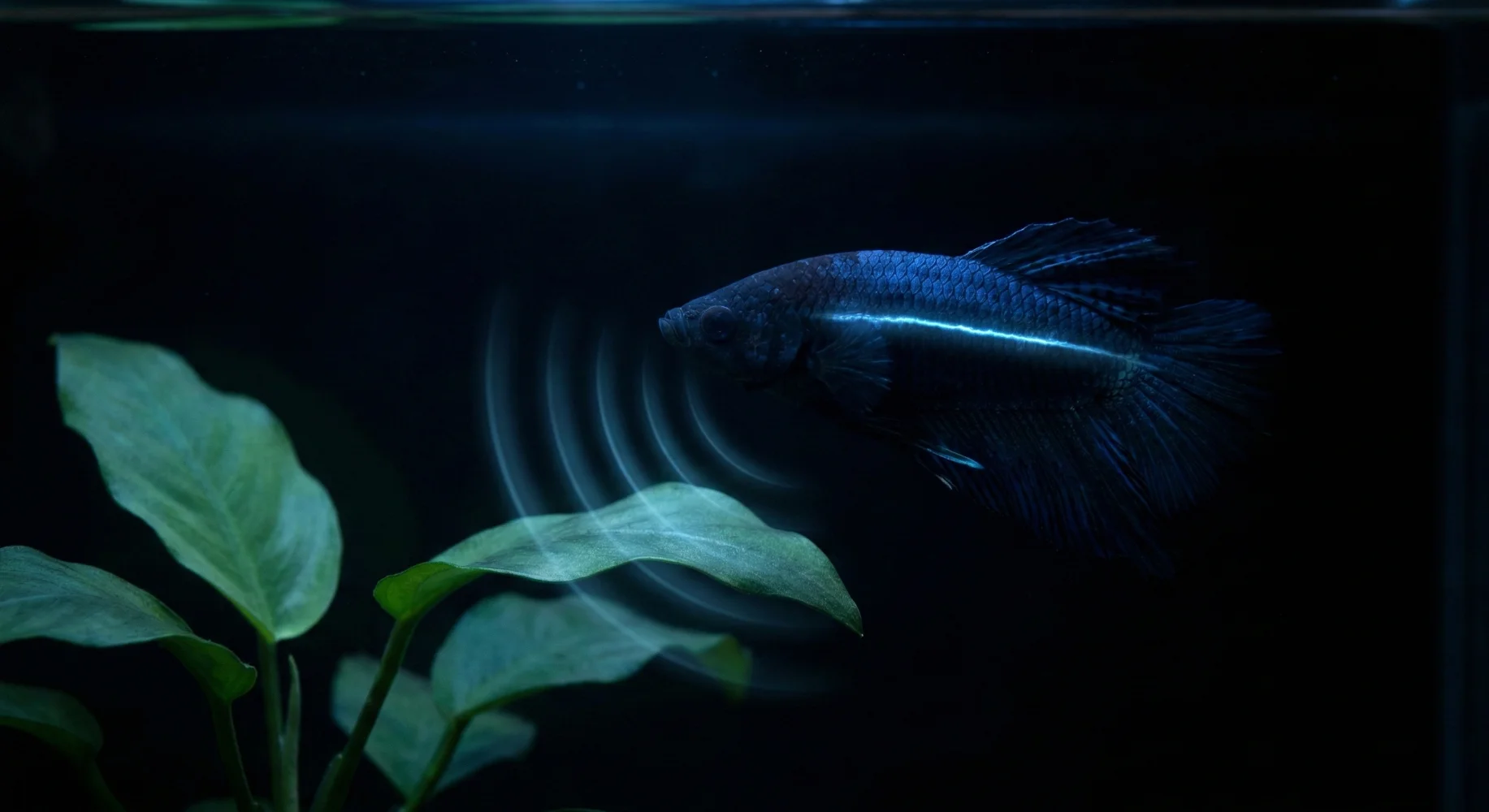
We humans are terrified of the dark. We assume our pets are too. When you turn off the last light in the house and the room goes pitch black, many owners wonder: “Is my Betta scared? Is he bumping into the glass? Is he lost?”
It’s 11:00 PM. You turn off your aquarium light, then you turn off your room light. The house is pitch black.
You might worry: “Is my Betta okay? Can he see where he is going, or is he crashing into decorations like a Roomba in the dark?”
The short answer is: No, he cannot see in total darkness. The long answer is: He doesn’t need to, because he has a “superpower” that you don’t.
Here is the science of what happens in your tank when the lights go down.
1. The Biology: Rods vs. Cones
Like humans, Betta eyes have two types of receptors:
- Cones: For bright light and color. (Bettas have amazing color vision).
- Rods: For low light and motion detection.
Bettas are diurnal animals (active during the day), just like us. They do not have the specialized “night vision” eyes of nocturnal animals like cats or owls. They lack a tapetum lucidum (the layer that makes a cat’s eyes glow in the dark).
Verdict: In pitch blackness, your Betta is blind. In dim moonlight or ambient street light, he sees blurry gray shapes and shadows.
2. The “Sixth Sense”: The Lateral Line
If he can’t see, why doesn’t he smash into the glass at night?
Fish have a secret weapon called the Lateral Line System. If you look closely at the side of your Betta, you might see a faint line running from his gills to his tail.
This organ is like Sonar or Radar. It detects tiny changes in water pressure and vibrations.
- When a Betta swims toward the glass in the dark, he creates a pressure wave ahead of him. That wave bounces off the glass and hits his lateral line.
- Translation: He “feels” the wall before he sees it.
This is how they navigate murky, muddy rice paddies in the wild where visibility is zero, day or night.
3. Why They NEED Darkness (The Sleep Cycle)
Here is the most important part: Your Betta has no eyelids. He cannot close his eyes to sleep.
If you leave a light on 24/7, or if your room is always bright, his brain never fully rests. Imagine trying to sleep with your eyes taped open under a fluorescent office light.
- Total Darkness signals “Rest Time.” When the lights go out, his metabolism slows down, he finds a favorite leaf or corner near the surface, and he enters a state of rest.
- Do not use a bright “Moonlight.” Those blue LEDs sold as “night lights” are often too bright. If the tank is bright enough for you to see the fish clearly, it’s too bright for him to sleep deeply.
4. The “Flashbang” Warning
Because their eyes adjust slowly to light changes: Never turn a bright tank light on suddenly in a pitch-black room.
It shocks them. It’s like someone shining a tactical flashlight in your face while you are sleeping. You will see your Betta dart wildly and crash into things in panic.
- The Rule: Turn on a dim room light first for 5 minutes, then turn on the bright tank light. Give his eyes time to wake up.
Summary: The Shop Guy’s Verdict
Don’t worry about your Betta being scared of the dark. He prefers it. He isn’t Batman—he can’t see much—but his sonar allows him to navigate safely to his bed.
Do him a favor: Turn the lights off, make the room dark, and let the little guy get some sleep.