When people ask how long guppies live, the internet gives a clean, easy answer: “Two to three years.”
That answer is technically correct. It’s also deeply misleading. Because in a real home aquarium, almost no guppy actually lives that long.
If you’ve kept guppies for any amount of time in Malaysia, you already know this. One day they’re fine—active, colorful, eating like pigs. A few weeks later, one disappears. No spots. No fungus. No dramatic illness.
Just… gone. So what’s really happening?
The “Paper Lifespan” vs. Real Life
Yes, guppies can live three years. But that number assumes:
- Perfectly stable genetics.
- Zero stress from tank mates.
- Controlled breeding (or no breeding at all).
- Constant, perfect mineral levels.
- No transport trauma from the LFS to your house.
In other words: laboratory conditions. In real home aquariums, especially in colonies, most guppies live 8 to 14 months. Some make it past a year. Very few reach two. That doesn’t mean you’re failing. It means guppies live fast.
Guppies Age Faster Than You Think
Guppies are not slow, long-term fish like Goldfish or Plecos. They are built for speed:
- They are born ready to swim.
- They are sexually mature in weeks.
- They are constantly reproducing.
- They are always “on.”
Their bodies burn through energy at an incredible rate. Think of them like short-lived mammals. A guppy’s entire life—childhood, adulthood, and old age—is compressed into a single year. By the time a female guppy gives birth three times, she is already “middle-aged.”
Breeding Is Exhausting (Especially for Females)
This is the part most care guides gloss over. Female guppies don’t just give birth once; they are biological machines.
- They store sperm.
- They drop fry every 28 days.
- They produce dozens of babies at a time.
Even without a male present, a female can keep giving birth for months. That takes a massive toll on her body. You’ll notice it if you watch closely:
- A slightly hunched posture.
- Slower swimming.
- Less interest in food.
- Fading color.
They don’t “get sick.” They simply wear out. Many females die not from a virus, but from pure reproductive exhaustion.
Stress Kills Earlier Than Disease
Most guppies don’t die dramatically from a “breakout.” They die quietly from accumulated stress. In a typical tank, small things add up:
- Being chased constantly by males.
- Fluctuating water minerals in our tap water.
- Overcrowding as the fry grow up.
- Minor temperature swings during a rainy Malaysian afternoon.
No single stressor kills them. But together, they shorten the biological clock. By the time you notice something is “wrong,” the fish is already “old” in guppy years.
Fancy Guppies Live Shorter (Usually)
This connects directly to genetics. Highly bred “Fancy” guppies often:
- Mature faster.
- Burn brighter.
- Crash earlier.
Long tails and heavy finnage look elegant, but they require massive amounts of energy just to carry around. Albino and extreme color strains often have weaker immune systems. While a “Wild Type” or “Longkang” guppy might cruise past 18 months without drama, a high-grade fancy male may peak at 8 months and then slowly decline.
What “Old Age” Looks Like in Guppies
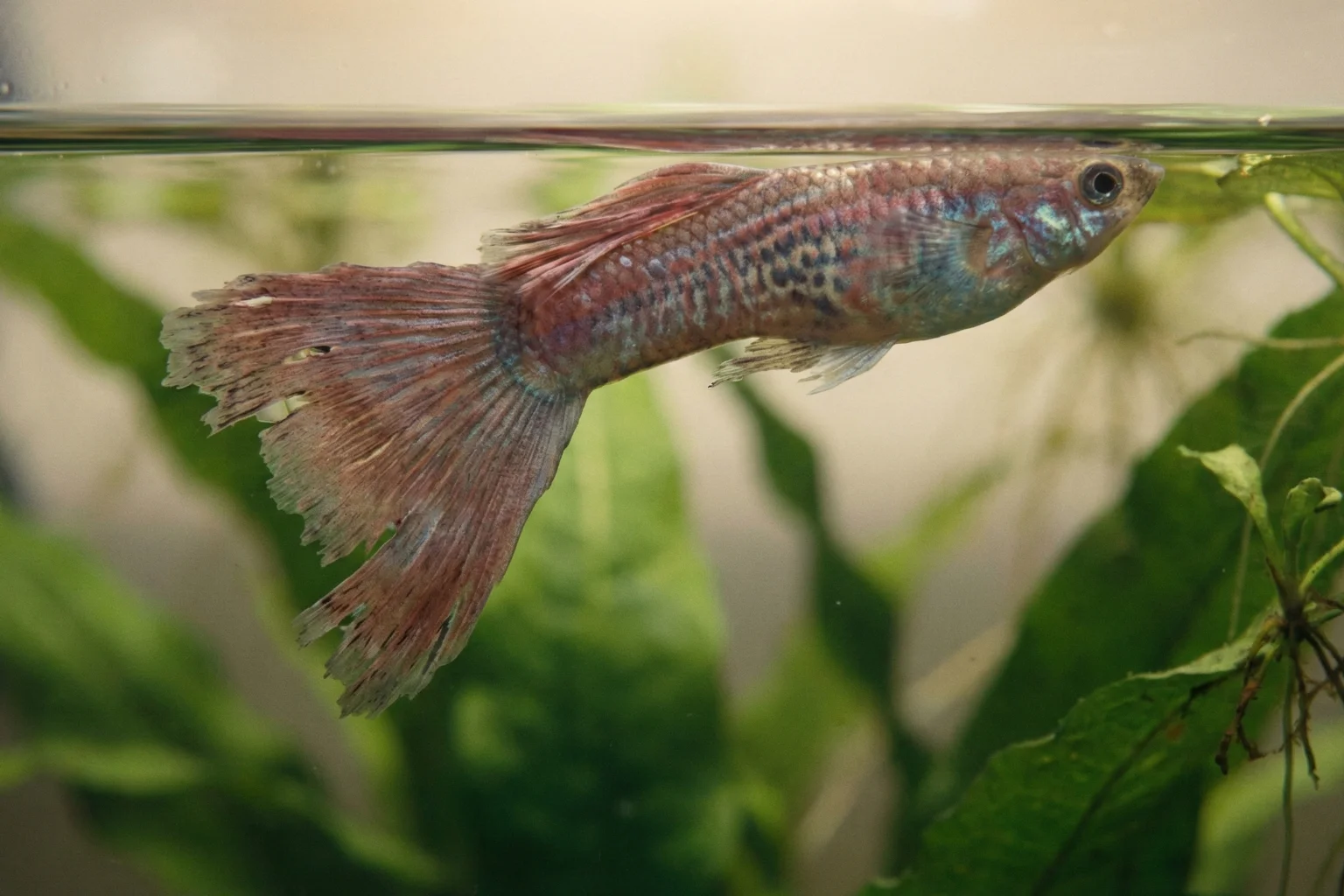
Guppies don’t turn grey or get wrinkles. Old age looks subtle:
- Less chasing and social interaction.
- More time spent resting near plants or the filter intake.
- Slower response when you drop food in.
- Slight fin fraying that never seems to heal.
They still eat. They still swim. They just… fade. And one day, they don’t wake up.
The Quiet Reality
Here’s the truth most guides won’t tell you: If you’ve kept a guppy alive and healthy for a full year—you didn’t fail. You succeeded.
Guppies aren’t meant to be lifelong pets like a cat or a parrot. They are meant to bloom briefly, pass on their genes, and disappear. That doesn’t make them disposable; it makes them temporary.
Bottom Line
Instead of asking: “Why did my guppy die so fast?” Try asking: “Did it live well while it was here?”
Was it active? Did it eat eagerly? Did it have space to swim instead of hiding in fear? If the answer is yes—you did your job as a keeper.