Most fish die quietly.
You miss a water change, the oxygen drops, and one morning they are just… gone.
But a Channa survives.
This is why beginners often think Channa are “easy” or “bulletproof.” They live through mistakes that would kill tetras, guppies, or even goldfish. But this toughness hides a dangerous misunderstanding.
Channa don’t survive because they are simple.
They survive because they are different.
To keep them properly, you need to understand one thing first:
Channa are air-breathers.
1. The Secret Organ That Changes Everything
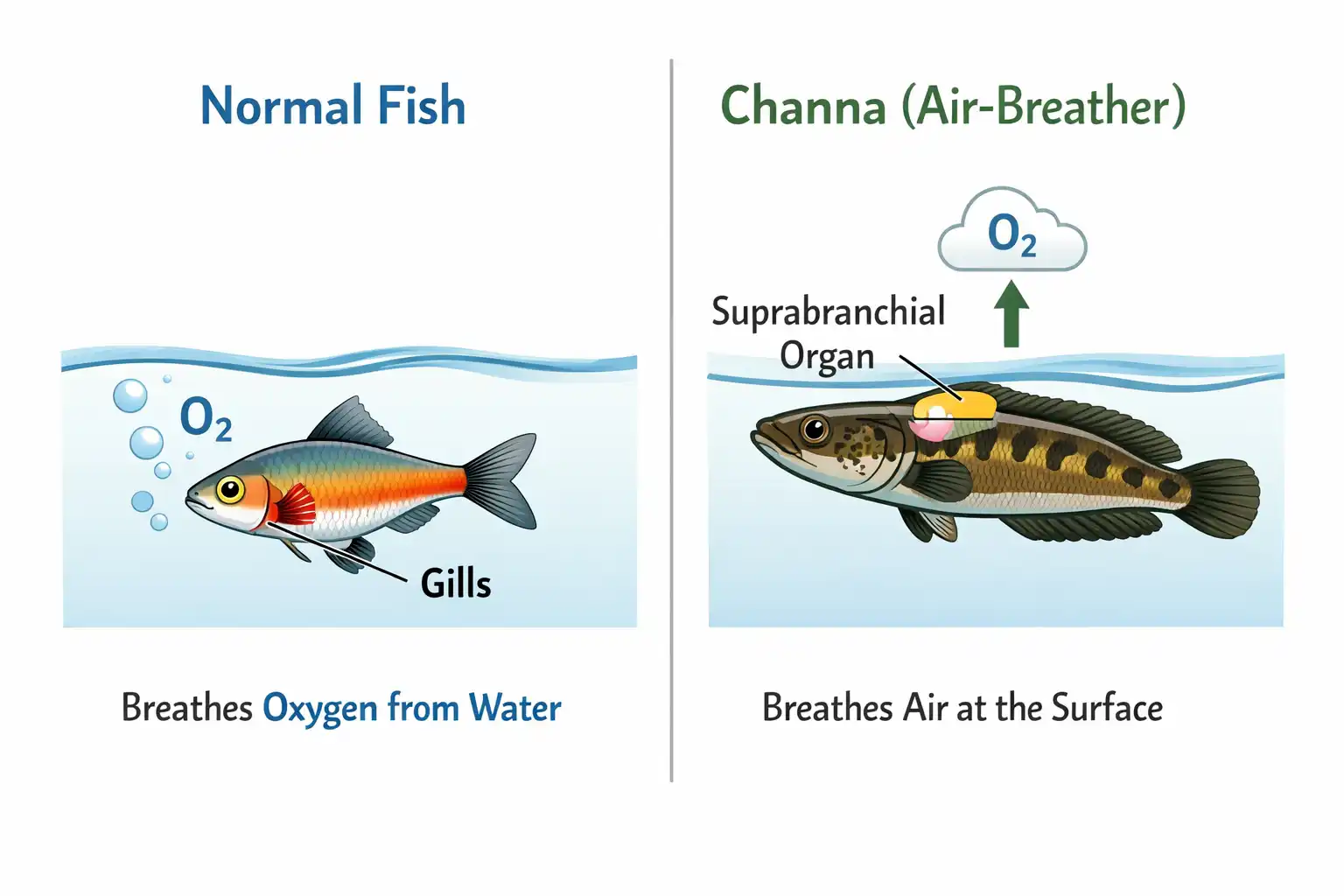
Channa are not fully dependent on oxygen dissolved in water.
They possess a special structure called a suprabranchial organ — a primitive lung-like chamber above the gills. This allows them to gulp air from the surface and absorb oxygen directly.
In the wild, this lets them:
- Survive in stagnant puddles
- Live in muddy, oxygen-poor water
- Travel short distances between pools during droughts
In an aquarium, this ability completely changes how they must be kept.
They are not just swimming in water.
They are living between water and air.
2. Why “Low Oxygen” Doesn’t Kill Them (But Other Fish Do)
This is where many owners get confused.
A Channa can survive:
- Poor surface agitation
- Overcrowded tanks
- Warm, oxygen-poor water
Meanwhile, other fish in the same tank start gasping or dying.
This creates a false sense of confidence:
“My tank is fine. My Channa is healthy.”
In reality, the tank may already be failing — the Channa is just the last fish standing.
This is why Channa often outlive tank crashes. They don’t mean the system is healthy; they mean the fish is adapted to hardship.
3. The Dangerous Lid Mistake (How People Suffocate Channa)
Because Channa are jumpers, owners instinctively seal the tank tightly with glass lids.
This is where tragedy happens.
A fully sealed glass lid traps humid, stale air above the water surface. Over time:
- Oxygen levels drop
- Carbon dioxide accumulates
- The air becomes harder to breathe
For a normal fish, this doesn’t matter.
For an air-breather, it can be fatal.
The fish surfaces, gulps air… and the air is bad.
This is one of the least talked-about causes of sudden Channa death.
The Rule
A Channa tank must be:
- Escape-proof
- But never airtight
This is why experienced keepers prefer mesh lids over solid glass. Mesh prevents jumping while allowing constant air exchange.
4. Why Surface Access Is Non-Negotiable
Channa must surface regularly.
If something blocks this behavior — floating decor, dense plastic covers, or aggressive tankmates — stress builds up quickly.
Signs your Channa is struggling to breathe:
- Repeated, frantic surfacing
- Hovering near the top
- Reduced appetite
- Sudden lethargy despite “good” water parameters
This is not a water problem.
It is an air problem.
5. The Irony: Tough Fish, Precise Needs
Here is the irony of keeping Channa:
They survive beginner mistakes, but they punish misunderstandings.
They can handle:
- Dirty water (to a point)
- Low oxygen
- Missed maintenance
But they cannot handle:
- Sealed air
- Poor surface access
- Unsafe lids
Many Channa don’t die slowly. They die suddenly — often at night — because their keeper misunderstood what kind of fish they really are.
Closing Thought
Channa are not “strong fish.”
They are specialized fish.
Once you understand that they breathe air, everything else makes sense:
- Why mesh lids matter
- Why jumping is instinctual
- Why they feel more like pets than decorations
If you treat a Channa like a normal fish, you will eventually lose it.
If you treat it like a creature living between two worlds, it will thrive.