
(It’s Watching for Food)
There’s a moment every fishkeeper experiences.
You walk past the tank.
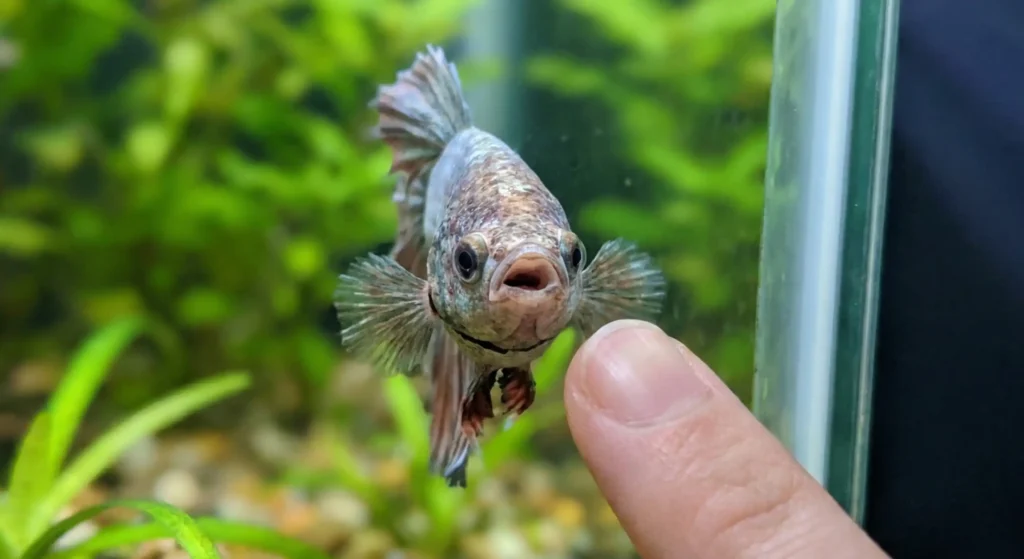
The fish rushes forward.
It stops.
It just… stares at you.
And your brain quietly goes:
“Oh. It recognizes me.”
That feeling is powerful. It feels personal.
It feels like connection.
But here’s the uncomfortable truth:
Your fish isn’t watching you.
It’s watching what usually happens when you appear.
Why the Staring Feels So Personal
Fish don’t blink.
They don’t look away awkwardly.
They don’t pretend they weren’t just watching you.
So when a fish parks itself at the glass and locks eyes with you, it feels intense. Almost emotional.
Especially if:
- It only does this to you
- It swims away when strangers approach
- It follows your movement across the tank
It looks like recognition.
And in a way… it is.
Just not in the way we want it to be.
What’s Actually Happening in the Fish’s Head
Fish are very good at associating patterns.
Not feelings.
Not relationships.
Patterns.
You appear → food appears
Shadow near tank → food appears
Movement at glass → food appears
Over time, your fish doesn’t see you.
It sees a prediction.
You’re not a person to them.
You’re a signal.
That’s why the fish rushes forward.
That’s why it “waits.”
That’s why it stares.
It’s not watching you.
It’s watching the moment before feeding.
“But It Only Does This to Me”
Yes. Exactly.
Because you’re consistent.
You feed at roughly the same time.
You stand in the same spot.
You move the same way.
Fish are incredibly good at learning:
- who feeds them
- when food usually comes
- what movements matter
This isn’t love.
It’s not trust either.
It’s conditioning.
And here’s the part most people don’t realize:
This is how overfeeding starts.
How “Staring” Slowly Kills Fish
When a fish stares at you, it looks like it’s asking.
So we give.
A pinch more food.
An extra pellet.
“One more, it’s still looking at me.”
But the fish never stops looking.
Because it’s not asking — it’s anticipating.
Fish don’t feel “full” the way we do.
They don’t know when the next meal is coming.
In nature, hesitation means starvation.
So they keep signaling.
And we keep responding.
That’s how:
- bloating happens
- water quality degrades
- ammonia spikes quietly
- fish “randomly” die weeks later
Not from disease.
From misunderstanding.
The Quiet Irony
The better you care for your fish,
the more likely this behavior appears.
Healthy fish are alert.
Healthy fish learn quickly.
Healthy fish respond to patterns.
So the staring isn’t a sign of affection.
It’s a sign your fish is functioning well.
We just misread it.
What to Do Instead (Without Feeling Guilty)
You don’t need to stop enjoying the interaction.
You just need to break the automatic loop.
A few gentle shifts:
- Feed on a schedule, not a stare
- Walk past the tank without responding sometimes
- Let the fish learn that not every appearance = food
Over time, the staring softens.
The fish relaxes.
The tank becomes calmer.
Not because the fish likes you less.
But because it’s no longer stuck waiting.
A Better Way to Think About It
Your fish isn’t watching you.
It’s watching the future.
And the most caring thing you can do
is teach it that the future isn’t always food.