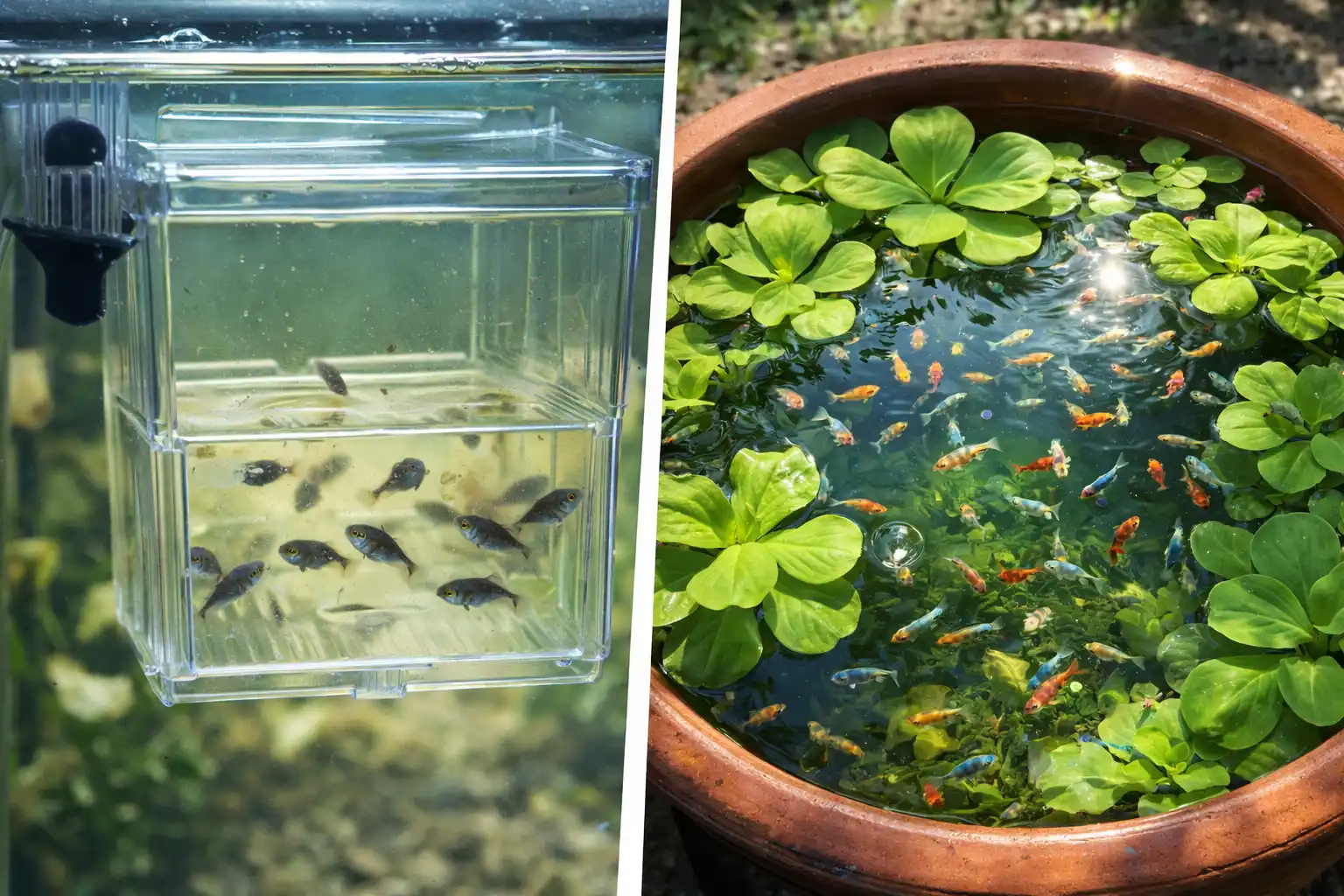
If you walk into my shop and ask, “How do I save more baby guppies?”, I won’t sell you a plastic breeding box.
I won’t sell you expensive “Liquifry” food.
I will tell you to go to a nursery, buy a cheap RM15 clay lotus pot, and put it outside.
In the US and UK, they have to struggle with heaters and grow lights. But here in Malaysia, we have the ultimate advantage: Tropical Weather.
Raising fry indoors usually gets you a 50% survival rate. Raising them outdoors often hits 90%.
Here is why the “Lazy Pond” method works better than high-tech equipment.
1. The “Green Water” Secret (Free Food)
The biggest killer of guppy fry isn’t other fish—it’s starvation.
Fry have tiny stomachs. They need to eat constantly, but you can’t be home to feed them powder 8 times a day.
When you put a pot outdoors under indirect sunlight, the water turns slightly green.
- New Keepers Panic: “Oh no, algae!”
- Expert Keepers Smile: “Free food.”
That green water is full of Infusoria and micro-algae. It is a 24/7 buffet for baby guppies. They can graze non-stop, which makes them grow twice as fast as fry fed on dry flakes indoors.
2. The “Growth Hormone” Trap
Have you ever noticed that fry in a small breeding box stop growing after 2 weeks?
Fish release hormones into the water that inhibit the growth of other fish. In a tiny plastic box, these hormones build up fast. The fry literally “stunt” each other.
In an outdoor pot (even a 10-gallon one), the volume of water dilutes these hormones. The fry feel like they are in the wild. They eat more, swim more, and get bigger bodies.
3. The Mosquito Myth (Solved)
Many Malaysians are scared to keep outdoor water because of Dengue and Aedes mosquitoes.
Let me be clear: A guppy pot is the safest water in your neighborhood.
Guppies are natural mosquito control. A single 1-month-old guppy can eat 50 mosquito larvae in a day. By keeping an outdoor guppy pond, you are actually reducing the mosquito population in your garden, because the mosquitoes will lay eggs in your pot, and your fish will eat them before they hatch.
It is a trap, and the fish are the exterminators.
The Danger: The Dragonfly Nymph
There is only one real enemy in an outdoor pond.
The Dragonfly Nymph.
Dragonflies lay eggs in water. Their babies (nymphs) look like alien bugs with pincers, and they are masters of camouflage. They will hunt and eat small guppies.
The Fix:
- Cover your pot with a simple netting (like a mosquito net) to stop dragonflies from laying eggs.
- If you see a weird “bug” crawling on the underwater plants, remove it immediately.
How to Set Up Your “Lazy Fry Pot”
- The Container: Any large pot (plastic or clay) that holds at least 20 liters.
- The Plants: Fill it with Water Lettuce (Kiambang) or Hornwort. This provides shade (so the water doesn’t get too hot) and hiding spots.
- The Water: Use old tank water to start it. Let it sit for 3 days until you see a bit of algae forming.
- The Fish: Put your pregnant female in. Let her give birth. Then move her back inside.
- The Maintenance: Do nothing. Just top up water when it evaporates. Feed a tiny pinch of powder once a day (the green water does the rest).
Summary: Indoor vs. Outdoor
| Feature | Indoor Breeding Box | Outdoor Pot |
| Food Source | You must feed 5x a day | Natural Algae / Infusoria |
| Water Quality | Gets dirty fast (ammonia spikes) | Plants absorb waste |
| Growth Speed | Slow (Stunted) | Turbo Mode |
| Survival Rate | ~50% | ~90% |