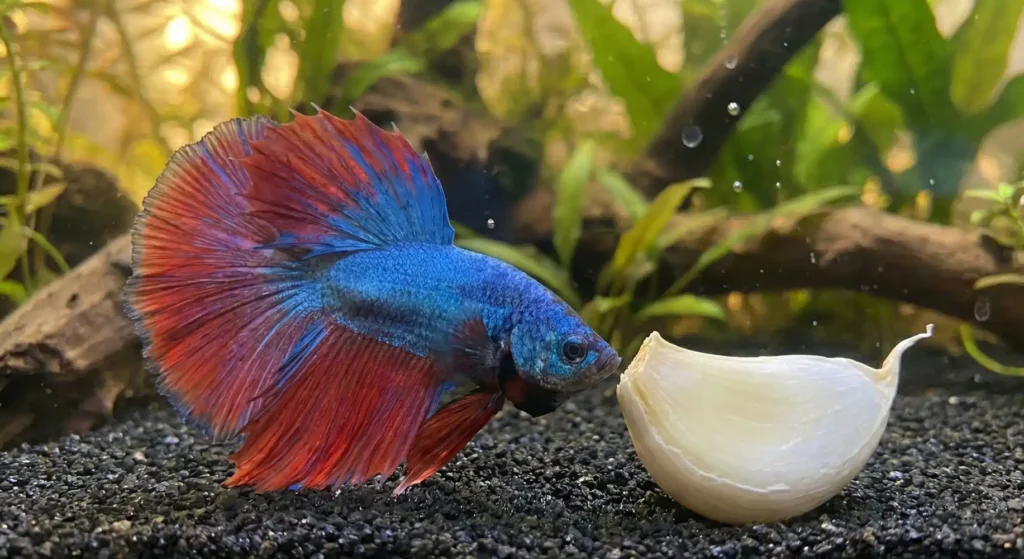
You look at a Halfmoon Betta and think: “Nature is amazing.” Wrong. Nature didn’t make that. We did.
If you went back in time to 1850 and showed a Thai farmer a modern Blue Halfmoon, he would laugh at you. “That fish is useless,” he would say. “It swims too slow. It would die in 5 seconds in a fight.”
The Betta fish is not a natural animal anymore. It is a design object, like a Pug dog or a Ferrari. Here is how we built it.
Phase 1: The “Gladiator” Era (1850s – 1900)
Goal: Make them mean.
Long before they were pets, they were warriors. In the 1800s, children in Siam (Thailand) and Malaya (Malaysia) would catch wild Bettas (Betta Splendens) from rice paddies. These wild fish were brown, small, and had short fins.
- The Sport: Farmers started breeding the winners. They didn’t care about color. They cared about Teeth, Scales (armor), and Aggression.
- The “Plakat“: This selective breeding created the Plakat (Thai for “Biting Fish”). It was a biological tank.
- The King’s Tax: The sport became so popular that in the 1840s, King Rama III of Siam actually collected taxes on fighting fish licenses! He was arguably the world’s first “Betta Hobbyist.”
Shop Guy Fact: This is why we still call them Ikan Laga (Fighting Fish) in Malaysia. The aggression isn’t a bug; it’s a feature we spent 100 years programming into them.
Phase 2: The “Happy Accident” (1900 – 1960s)
Goal: Make them pretty.
Sometimes, a fierce Plakat would have a baby with a genetic defect: Long Fins. In the fighting ring, these “long fins” were a disaster. The enemy would shred them. Farmers threw these “defective” fish into the drain.
But in the early 1900s, Western explorers (Europeans and Americans) arrived. They saw these “defective” long-finned fish and said: “Wait, these are beautiful!”
- 1927 (The Veiltail): American breeders imported these rejects and stabilized the “Long Fin” gene. The Veiltail (the droopy tail) was born. It became the most popular aquarium fish in the world.
- The Shift: For the first time, people were breeding for Beauty, not Blood.
Phase 3: The “Engineering” Revolution (1980s – 2000s)
Goal: Make them perfect.
This is where the “100 years” claim gets real. Breeders started treating fish like mathematics.
The Halfmoon (1987)
A French breeder named Guy Delaval and a team of Americans (the IBC) had a crazy idea: “Can we make a tail that opens to a perfect 180-degree semi-circle?” It took them 20 years of crossing specific bloodlines. In 1987, they finally succeeded. The “Halfmoon” was unveiled. It was sold for thousands of dollars. It was the first “Supercar” Betta.
The Crowntail (1997)
Ten years later, an Indonesian breeder named Achmad Yusuf in West Jakarta noticed a fish with “spiky” fins. Instead of culling it, he bred it. He created the Crowntail (Serit).
- The Impact: This put Southeast Asia back on the map as the “King of Bettas.” It was aggressive, distinct, and looked like a punk rocker.
Phase 4: The Modern Era (2010 – Now)
Goal: Make them impossible.
Today, we are in the “Remix” era. Breeders are now mixing Wild DNA back into domestic fish.
- The Alien: Crossing a Plakat with a Betta Mahachaiensis to get metallic “robot” scales.
- The Koi: Using “Jumping Genes” (Transposons) to create marble patterns that change color every week.
The Shop Guy’s Verdict
So, does the Betta represent 100 years of work? Yes. When you buy a Betta for RM 15, you are holding a living antique.
- He has the aggression of a 1850s Siamese gladiator.
- He has the fins of a 1920s American experiment.
- He has the tail span of a 1980s French mathematical equation.
He is a little swimming history book. Respect him.