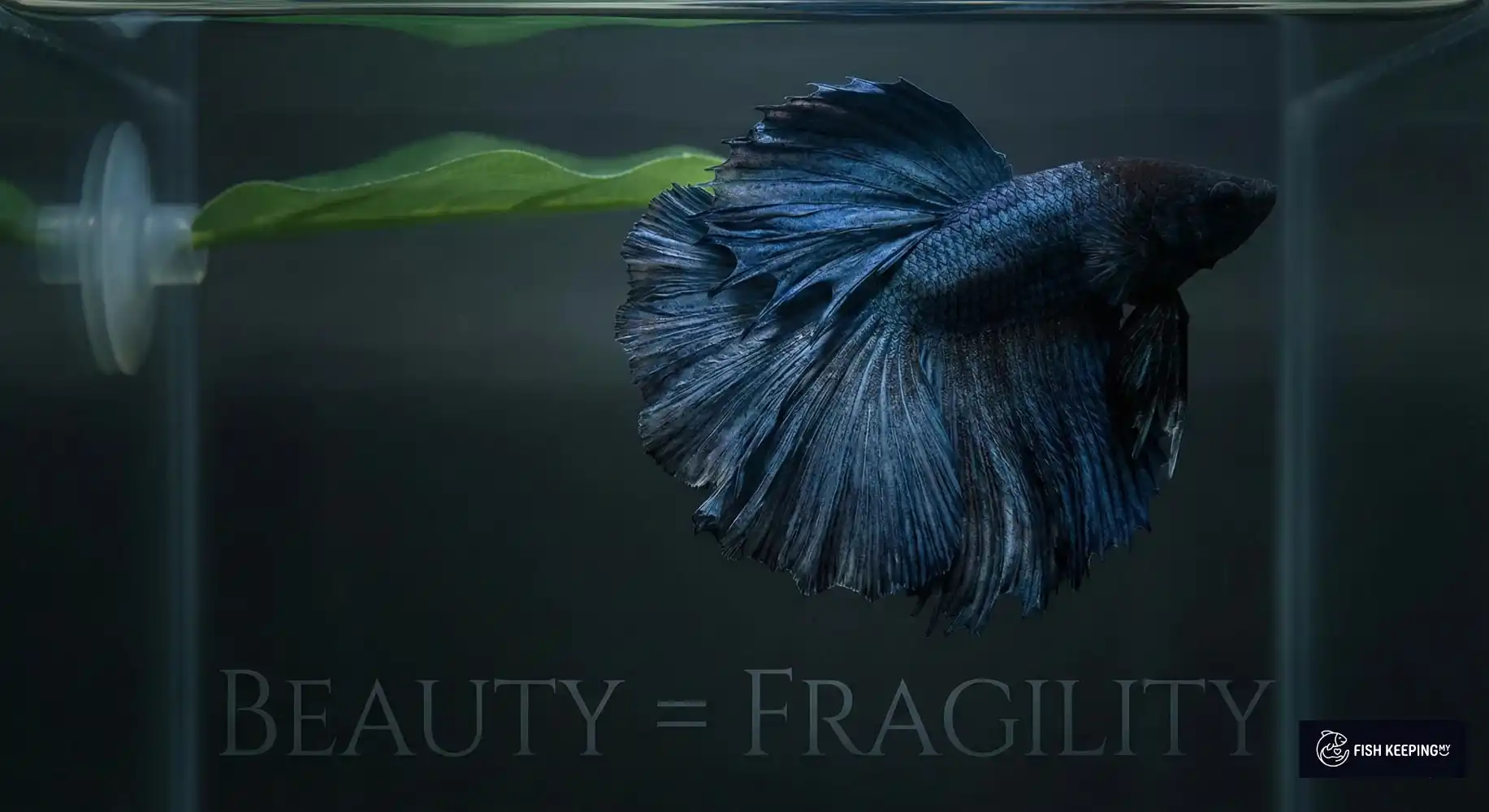
This is the fish that made the hobby famous. When someone says “Betta,” they picture the Halfmoon (HM). Huge, flowing fins that spread exactly 180 degrees like a Spanish dancer’s fan.
But here is the “Shop Guy” secret: I hate selling these to beginners. Why? Because they are the “Ferraris” of the fish world. Stunning to look at, but they break down if you look at them wrong.
The Halfmoon (HM) is a genetic masterpiece. Breeders spent decades refining this fish so that when it flares, the tail forms a perfect 180-degree letter “D”. If it is less than 180 degrees, it is a Super Delta (SD). If it is more than 180 degrees (over-lapping), it is an Over-Halfmoon (OHM).
But beauty comes at a price. The Halfmoon is genetically weak, physically burdened, and prone to depression. Yes, your fish can get depressed.
1. The “Wedding Dress” Physics
Imagine trying to swim while wearing a heavy, water-logged wedding dress. That is the life of a Halfmoon.
- The Drag Factor: Their fins are huge but their muscles are the same size as a Plakat.
- The Consequence: They get tired easily. A Halfmoon cannot swim in strong current. If your filter flow is too strong, he will be blown around like a plastic bag. He will eventually collapse and die from exhaustion.
- The Fix: You need Zero Flow or Low Flow. Use a Sponge Filter, or baffle your HOB filter outlet with a sponge.
2. The “Tail Biting” Phenomenon (The Nightmare)
This is specific to Halfmoons and Rosetails. One day, you wake up and half his tail is gone. There are chunks missing. Did a ghost eat it? No. He ate it himself.
- Why?
- Weight: The tail is too heavy. He bites it off to swim faster.
- Stress: He is bored or sees his reflection too much.
- Genetics: Some lines are just neurotic.
- The Cure: There is no pill. You must lower the water level (to reduce swimming effort), add more hiding spots, and keep the water pristine to prevent infection in the open wounds.
3. The “Fin Rot” Magnet
Plakats can survive in dirty water (don’t do it, but they can). Halfmoons cannot.
- Poor Circulation: Because the fins are so long, blood circulation to the tips of the tail is weak.
- The Rot: If Ammonia spikes even a little bit, the edges of the tail turn black and melt away. This is Fin Rot.
- The “Snag” Test: Their fins are like tissue paper. If you have plastic plants or sharp rocks, they will tear.
- The Pantyhose Rule: Rub a pair of ladies’ stockings over your driftwood/rock. If it snags the stocking, it will rip your Betta’s fins. Sand it down or remove it.
4. The “Rosetail” Warning (Do Not Buy)
If you think Halfmoons are hard, wait until you see the Rosetail or Feather Tail. These are mutated Halfmoons with excessive branching in the fin rays (the fins look like ruffled flower petals).
- The Truth: These fish are practically handicapped. The fins are so heavy they often cannot swim properly. They almost always bite their tails or develop “ray collapse.”
- Shop Guy Advice: Avoid them. Stick to standard Halfmoons.
5. Essential Care Checklist for Halfmoons
If you insist on buying one (and I know you will, they are gorgeous), follow these strict rules:
- Tank Size: 5 Gallons minimum, but Shallow. (See our Tank Depth Guide).
- Water: Add Ketapang (Indian Almond Leaf) extract. The tannins toughen their scales and fins, acting as a natural antiseptic against Fin Rot.
- Resting Spots: He needs a “Betta Hammock” or a floating log near the surface. He will need to rest often.
- Exercise: Use a mirror for 2 minutes daily. Flaring pumps blood to the end of the fins, keeping them healthy. (See our Reflection Guide).
The Shop Guy’s Verdict
The Halfmoon is a “Show Fish.” It is meant to be looked at, not played with.
- If you are lazy with water changes: Do not buy it. It will rot.
- If you have strong flow: Do not buy it. It will die.
- If you are willing to treat it like a Princess: It will be the most stunning jewel in your room.