If there is one way to kill a Betta faster than dirty water, it is kindness.
Every day, customers walk into my shop asking why their fish is floating sideways or looks like a balloon.
The answer is almost always the same: You are feeding him too much.
In this comprehensive guide, we are going to throw away the “3-minute rule” written on the jar and teach you how to feed your Betta like a professional breeder.
1. The Anatomy of a Hunter (Why Flakes Fail)
To understand what your fish needs, look at his mouth.
It is upturned. It is designed to snatch bugs from the water surface.
In the wild, Bettas are Carnivorous Insectivores. They eat mosquitoes, larvae, and tiny insects. They do not eat bread, plants, or algae.
Why I Ban Flake Food in My Shop
Most beginners buy flake food because it is cheap. Here is why you should throw it in the trash:
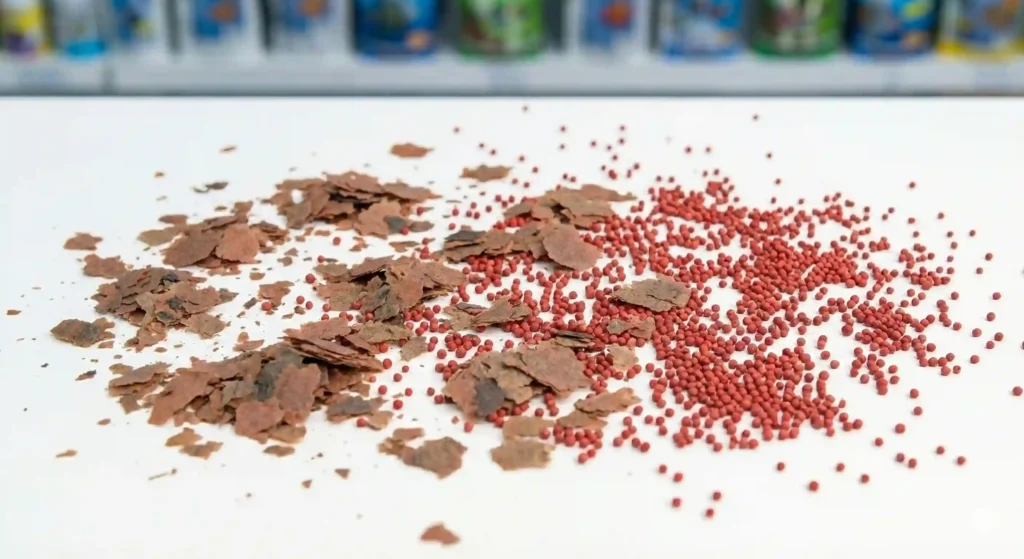
- The Mess: Flakes begin dissolving the second they hit the water. What the fish doesn’t eat instantly turns into liquid Ammonia.
- The Fillers: Most flakes are made of wheat and potato starch. Your Betta cannot digest carbs well. It makes him bloated.
- The Bloat: Because flakes float flat, the fish gulps air while trying to eat them. This leads to Swim Bladder issues.
The Pro Choice: Always use Floating Pellets. They are clean, nutrient-dense, and mimic the “bug” shape your fish is programmed to hunt.
2. Choosing the Right Weapon: Best Food Types
Not all pellets are created equal. I have seen RM2 pellets that are basically colored sawdust.
A. High-Quality Pellets (The Daily Driver)
Check the ingredients label. The first ingredient must be a whole protein source (e.g., “Whole Fish Meal,” “Krill,” “Squid”). If the first ingredient is “Wheat Flour,” put it back.
- Top Pick: Hikari Bio-Gold Betta. It is perfectly sized and doesn’t cloud the water.
- Premium Pick: Fluval Bug Bites. Made from soldier fly larvae. Excellent for picky eaters.
B. Frozen Food (The “Steak Dinner”)
Frozen blocks of Bloodworms or Brine Shrimp are the best treat you can give.
- Pros: High protein, high moisture (prevents constipation).
- Cons: Messy. You must defrost them first.
- Frequency: Once or twice a week. (Do not feed Bloodworms every day; they are too rich and fatty).
C. Freeze-Dried Food (The “Junk Food”)
You see those tubs of dried bloodworms?
They are like potato chips. Tasty, but dangerous.
- The Danger: They are bone-dry. When your fish eats them, they expand in his stomach, absorbing water. This causes massive constipation.
- The Fix: If you must use them, soak them in a cup of tank water for 5 minutes before feeding.
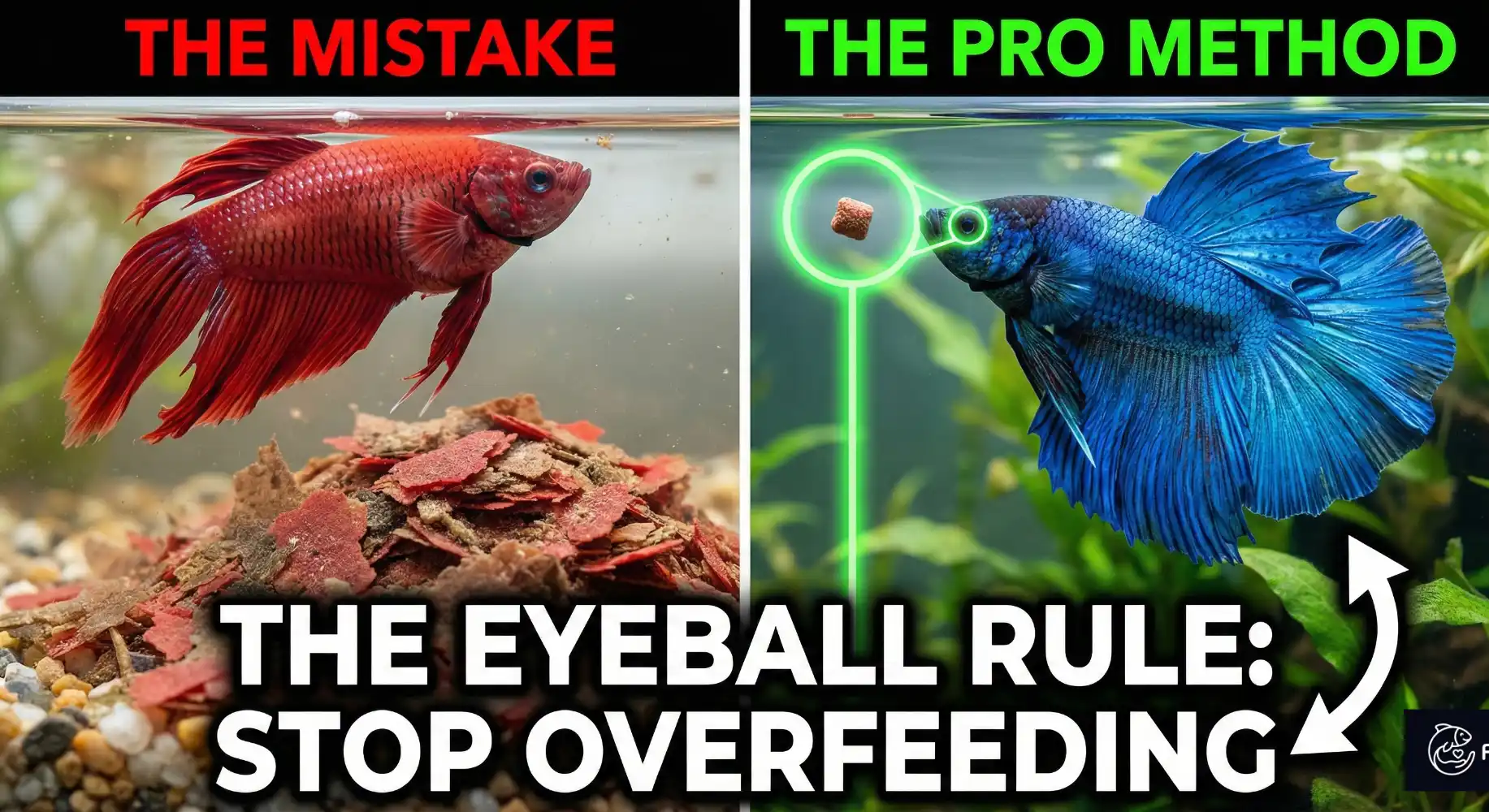
3. The “Eyeball Rule”: How Much is Too Much?
Ignore the instructions on the package that say “Feed what he can eat in 3 minutes.”
A healthy Betta is a pig. He can eat for 3 minutes straight and explode.
The Stomach Visualization
Your Betta’s stomach is roughly the size of his eyeball.
Look at his eye. Now look at the pellet.
- Standard Pellets: 2 to 3 pellets per meal is a full stomach.
- Giant Bettas: 5 to 8 pellets.
- Micro Pellets: 4 to 5 pellets.
The Golden Schedule:
- Morning: 3 Pellets.
- Night: 3 Pellets.
- Total: 6 Pellets per day.
4. The “Shop Guy” Secret: The Sunday Fast
This is the trick that saves lives.
In the wild, Bettas don’t find food every single day. Their digestive systems need a break to clear out waste.
If you feed them 7 days a week, the food piles up inside them, leading to blockages.
The Strategy:
- Monday to Saturday: Feed normal meals.
- Sunday: NO FOOD.
- Let him hunt for leftovers or graze on micro-fauna. This 24-hour fast allows his body to fully digest the week’s food and prevents constipation.
5. Comparison: Which Food Wins?
| Feature | Pellets (High Quality) | Flakes | Frozen (Bloodworms) | Live Food |
| Nutritional Value | High (Balanced) | Low (Fillers) | Very High (Protein) | Best (Natural) |
| Water Cleanliness | Excellent | Poor (Dissolves) | Moderate | Good |
| Convenience | Easy | Easy | Hard (Thawing) | Hard (Maintenance) |
| Risk of Disease | None | None | Low | High (Parasites) |
| Shop Guy Verdict | Winner (Staple) | Trash | Winner (Treat) | Experts Only |
6. Troubleshooting: “My Fish Won’t Eat!”
Before you panic, check this list.
Scenario A: The “New Fish” Tantrum
- Situation: You just bought him yesterday. He spits the food out.
- Cause: Stress. He is in a new environment.
- Solution: Starve him. Seriously. Don’t feed him for 2 days. He will not starve to death. When he gets hungry enough, he will eat whatever you give him.
Scenario B: The “Picky Eater”
- Situation: He eats bloodworms but refuses pellets.
- Cause: You spoiled him.
- Solution: Tough love. Stop the bloodworms. Offer pellets only. If he doesn’t eat, remove the food. Try again at night. Eventually, he will break.
Scenario C: The “Bloated Balloon”
- Situation: He is fat and floating sideways.
- Cause: Constipation / Swim Bladder Disease.
- Solution: Fast for 3 days. Then feed Daphnia (a tiny crustacean that acts as a laxative). Do not feed him peas (Bettas cannot digest plant matter well; Daphnia is safer).
7. FAQ: Common Feeding Questions
Q: Can I feed my Betta while I go on vacation for 5 days?
A: Do not feed him. Do not ask your neighbor to feed him (they will overfeed and kill him). Do not use those white “Vacation Blocks” (they ruin the water). A healthy adult Betta can survive 14 days without food. 5 days is nothing. He will be fine.
Q: Why does my Betta always beg for food?
A: Because he is smart. He associates you with food. He is the “dog” of the fish world. Do not fall for the “Puppy Eyes.” Stick to the schedule.
Q: Can I feed him ants or mosquitoes I catch?
A: Theoretically, yes. But be careful. If you catch a bug that has been exposed to pesticides (bug spray), you will poison your fish. It is safer to stick to shop-bought food.
Final Verdict
Feeding a Betta is simple:
- Buy high-quality Pellets.
- Feed the size of his eyeball (2-3 pellets).
- Fast him on Sundays.
If you follow this rule, you will avoid 90% of the health issues that kill Bettas. Remember: A slightly hungry fish is a healthy fish. An overfed fish is a ticking time bomb.