This is the scariest moment for a beginner. You wake up, look at your tank, and your beloved Betta is bobbing on the surface like a cork, struggling to swim down. Or worse, he is stuck on the bottom, dragging his belly like a heavy stone.
You think: “Is he broken? Is he dying?” The Shop Guy says: “He is probably just constipated.”
Swim Bladder Disease (SBD) is not actually a disease; it is a symptom of something else going wrong. Here is the deep-dive guide on why your fish lost his balance and how to act like an ER doctor to save him.
–
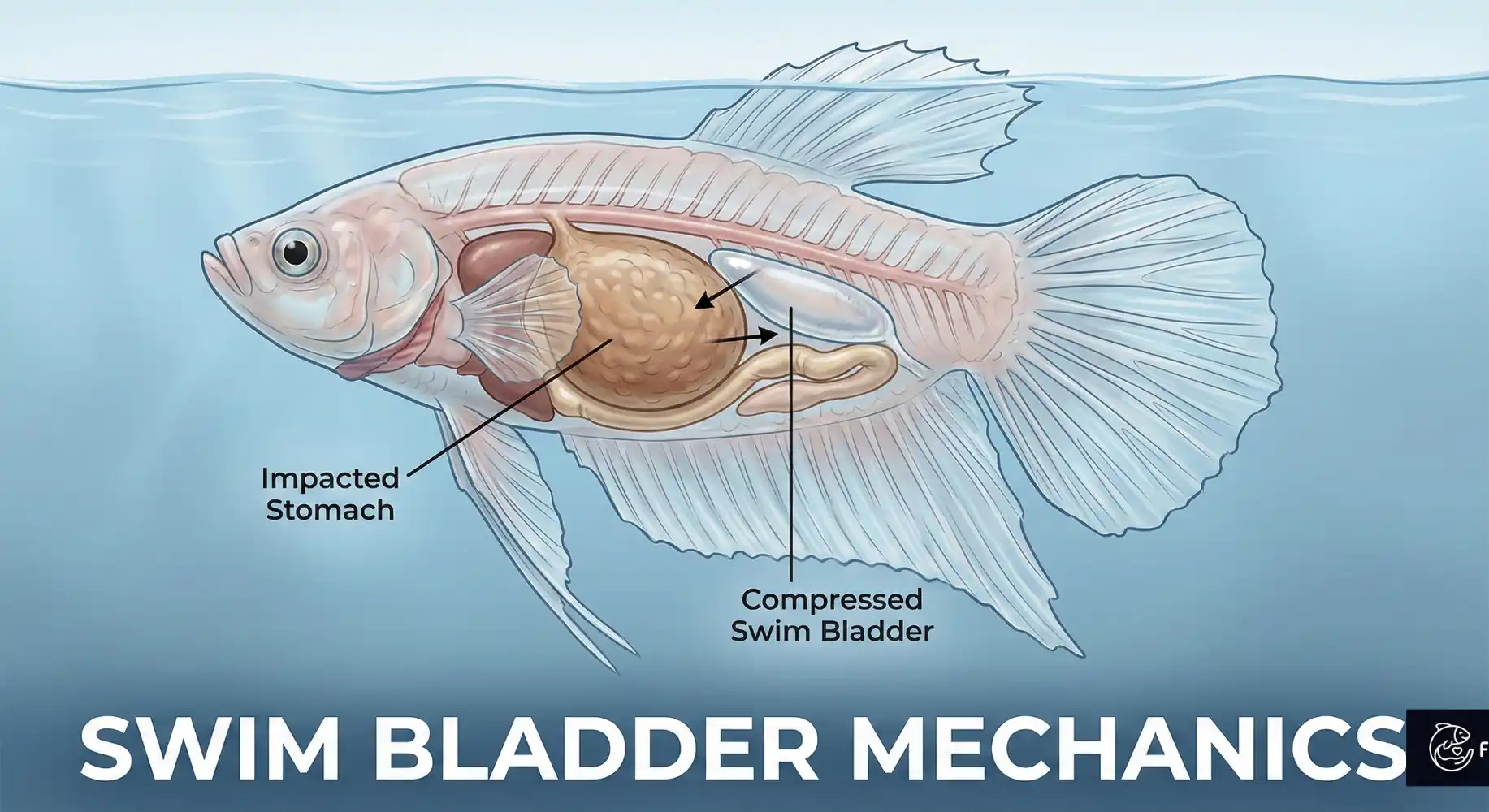
Imagine if you had a balloon inside your stomach that controlled whether you floated or sank in a pool. That is the Swim Bladder. It is a gas-filled sack that lets fish hover perfectly still.
When this organ malfunctions, your fish loses control of his buoyancy.
- The Floater: He cannot swim down. The air bladder is too full (positive buoyancy).
- The Sinker: He cannot swim up. The air bladder has collapsed or is compressed (negative buoyancy).
The Top 3 Causes (It’s Usually Your Fault)
1. Constipation (The #1 Culprit)
The Betta’s stomach is right next to the swim bladder. If he eats too much dry food, his stomach expands and physically crushes the swim bladder.
- Diagnosis: Bloated belly. Floating near the top. Still active but clumsy.
- Cause: Cheap dry pellets, overfeeding, no fiber.
2. The Cold Shock
Fish are cold-blooded. Their metabolism runs on heat.
- If your water drops below 24°C (75°F), their digestion stops. The food sits in their gut and rots, releasing gas that inflates the fish like a balloon.
- Diagnosis: Occurs during rainy season or in air-conditioned rooms.
3. Bacterial Infection
This is the serious one. Bacteria infect the bladder, causing fluid buildup or permanent damage.
- Diagnosis: Fish is skinny (not bloated) but still sinking/floating. Clamp fins. Lethargic.
The “Shop Guy” ER Protocol: How to Fix It
Do not just dump “Yellow Powder” (Antibiotics) in the tank yet. 90% of cases are just a tummy ache. Follow this order:
Step 1: The Fast (Starve Him)
Stop feeding immediately.
- Duration: 3 Days.
- Why: You need to let his system clear out the blockage. Adding more food is like adding cars to a traffic jam.
Step 2: The Heat Treatment
If your tank is in an AC room, turn off the AC or add a small heater.
- Target: Raise the temperature slowly to 27°C – 28°C.
- Why: Heat speeds up metabolism. It helps him poop.
Step 3: The Laxative (The Great Debate)
If he hasn’t recovered after 3 days of fasting, he needs help passing the blockage.
- Option A: Frozen Daphnia (The Pro Choice)
- What: Tiny water fleas.
- Why: They act as a mild laxative but are structurally “meat,” so they are safe for Bettas.
- Option B: The Boiled Pea (The Kitchen Hack)
- What: A frozen green pea, boiled, skin peeled, crushed into tiny bits.
- Why: It is pure fiber. It forces the gut to move.
- Warning: Bettas are carnivores. The pea is a “medicine,” not food. Do not feed this long-term.
Step 4: The Epsom Salt Bath (For Severe Bloat)
If he is huge and pineconing (scales sticking out), use Pure Epsom Salt (Magnesium Sulfate). Not Aquarium Salt.
- Dosage: 1 teaspoon per 5 Gallons (in a separate hospital container).
- Why: Epsom salt draws fluid out of the body, reducing the pressure on the swim bladder. Soak him for 15 minutes, then return him to the tank.
The “ICU Tank” (For Sinkers)
If your fish is sinking and struggling to reach the surface to breathe, he will drown from exhaustion. You must lower the difficulty level for him.
- Lower the Water: Drain the tank so the water is only 3 to 4 inches deep.
- Add Resting Spots: Put wide leaves (Ketapang or Anubias) near the surface so he can lay on them while keeping his mouth near the air.
- Bare Bottom: Remove gravel so you can see if he poops (a sign of recovery!).
Prevention: How to Stop It Coming Back
Once you cure him, don’t go back to your old ways.
- Soak Your Pellets: Put dry pellets in a drop of water for 2 minutes before feeding. This lets them expand outside the fish, not inside.
- Feed Less: Remember the Eyeball Rule.
- Check Genetics: sadly, Double Tail Bettas have shorter bodies and compressed spines. They are born prone to SBD. If you have one, be extra careful with food.
The Bottom Line
Swim Bladder Disease looks terrifying, but it is usually just a bad case of indigestion. Fast him, Warm him, and give him a Pea. He will likely be back to begging for food in a week.