I hear this question at least once a week. A customer stands in front of a tank of Goldfish or Guppies. They look at the tank—it has no sand, no plants, no fancy canister filter, maybe just a small bubbling sponge.
Then they look at the RM150 filter box I recommended and ask: “Eh Boss, your tank also empty. The fish look healthy what. Why I need to spend money on filter and sand? Can I just do like you?”
It’s a fair question. To the naked eye, it looks like we are keeping fish with “zero equipment.” But there is a huge difference between a Fish Shop (Stock Tank) and a Home Aquarium.
We aren’t keeping fish; we are “parking” them. Here are the 4 secrets why shops get away with using “no equipment”—and why trying this at home is a disaster.
1. The “Invisible” Filter (The Central Sump)
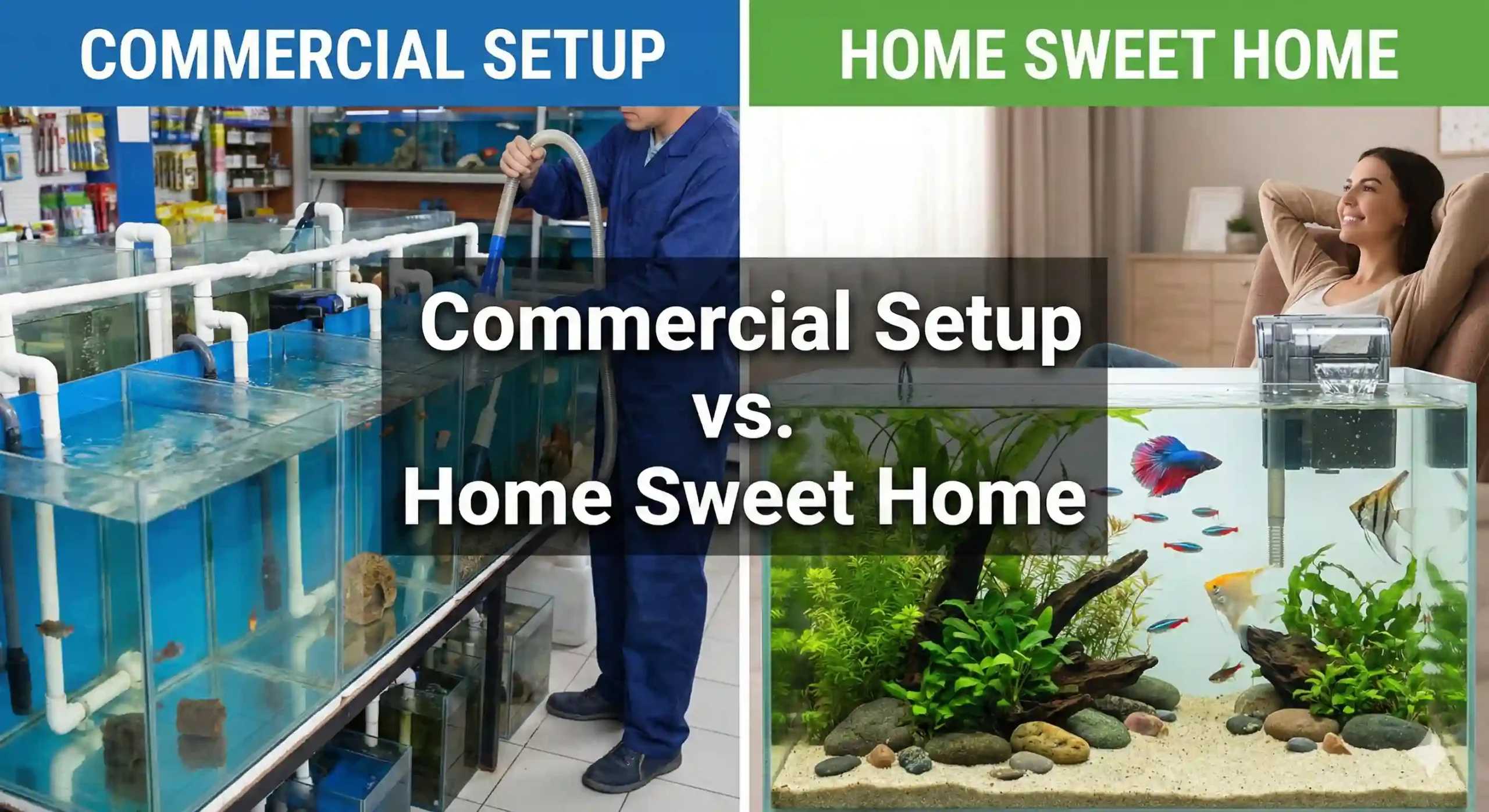
Next time you visit a big aquarium shop, look closely. Look behind the tanks, or look at the bottom rack. Do you see those PVC pipes connecting all the tanks together?
- The Illusion: You see a bare glass tank with a simple air stone.
- The Reality: That tank is connected to a Giant Central Sump hidden in the back room. That sump is 4 to 6 feet long and packed with kilograms of bio-media.
The water is circulating constantly through a massive commercial filter. So even though the individual tank looks “equipment-free,” it is actually running on a system 10x more powerful than anything you have at home.
2. The “Human Filter” (Daily Labor)
This is the biggest difference. You have a job; I work at the shop.
- You: Change water once a week (maybe, if you aren’t tired).
- Me: I change water every single day.
In a shop, we siphon the poop out of every bare-bottom tank every morning. When you remove waste immediately, it doesn’t have time to rot and turn into Ammonia. We don’t need powerful filters to trap dirt inside the tank because we are the mechanical filter. We manually remove the dirt before it becomes a problem.
3. The “Hotel” Rule (Short Term Stay)
A fish shop is a Hotel, not a Home.
- Your Goal: Keep the fish alive and happy for 2 to 5 years.
- My Goal: Keep the fish alive for 2 to 5 days (until you buy it).
Fish can survive in cramped, bare, low-oxygen conditions for a short time (survival mode). But if you keep them like that for months, they will stunt, get sick, and die. We keep them bare and crowded to save space and sell them fast. You shouldn’t copy this because you want your “pet” to thrive, not just survive.
4. The Ugly Sponge Secret
If the shop isn’t using a central sump, you will often see a simple, ugly black sponge filter bubbling in the corner. Beginners think this is “junk” equipment. Wrong.
That ugly, brown, dirty sponge is actually a biological powerhouse. It is full of beneficial bacteria. For a small tank, a seasoned sponge filter handles ammonia better than many fancy “internal filters” because it has more surface area. It’s not pretty, but it keeps the fish alive.
5. Why “Bare Bottom” is Safer for Us
You notice shop tanks almost never have gravel or sand?
- Reason: Gravel traps poop. Uneaten food sinks into sand and rots.
- Solution: With a bare glass bottom, the poop has nowhere to hide. The current blows it to the corner, and we suck it out in seconds. It looks ugly, but it is sterile.
The Shop Guy’s Take
Please, do not copy the Fish Shop setup.
If you set up a bare tank at home with no filter and crowd 50 fish inside:
- You won’t do water changes every day (you will get lazy).
- Ammonia will spike within 48 hours.
- Your fish will die.
We do it because it’s a business requiring high labor and high turnover. You buy the filter and gravel so you can enjoy the fish without working as hard as I do!