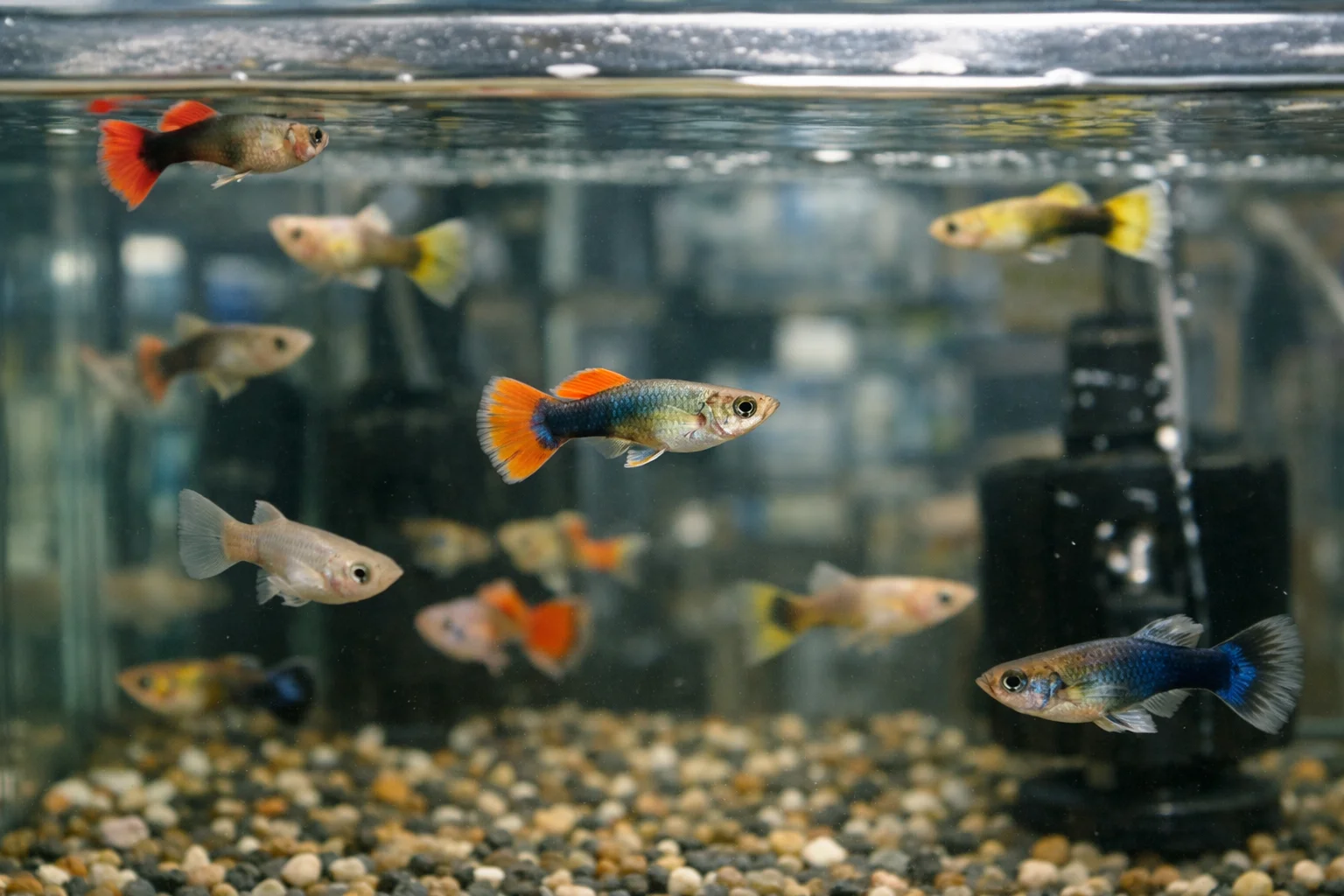
There’s a quiet moment in every fish shop. You’re standing in front of the guppy tank—lights buzzing, water a little cloudy, fish flashing colors at the glass. Some look incredible. Some look… tired.
Most people choose with their eyes. That’s understandable. In many shops, guppies are sold as “colors,” not as living animals. But if you want to be a successful keeper, you have to look deeper.
The truth is this: You can often predict which guppy will die first—if you know where to look.
Rule 1: Ignore the Prettiest One
It sounds counterintuitive, but the most colorful, flashiest guppy in the tank is often the worst choice. That fish is usually:
- The most stressed (getting chased by everyone).
- The most recently shipped (fresh off a stressful truck ride).
- Burning the most energy just to maintain those heavy fins.
Sometimes the best fish is the one quietly swimming at the side, behaving naturally, not begging for attention or gasping for life.
Rule 2: Watch Them Breathe (The Biggest Tell)
Almost nobody does this, but it’s the most important check. Look at the gills.
- Healthy guppies: Breathe calmly and rhythmically.
- Stressed guppies: Breathe fast, shallow, and constantly.
Fast breathing in a shop tank usually means ammonia damage, transport trauma, or internal weakness. No medication in the world will “reset” a fish that is already struggling to breathe before it even leaves the shop.
Rule 3: Check the Spine, Not the Tail
Don’t let a long, beautiful tail distract you. Ignore it for a second and focus on the spine.
- Straight from head to tail: This is a winner.
- S-curve or Hunchback: This is genetic weakness or a sign of old age/exhaustion.
Many guppies with slightly bent spines swim fine for now, but they almost never age well. A straight spine will always outlive a beautiful tail.
Rule 4: Fin Position Tells the Whole Story
Healthy guppies hold their fins open like a fan. Watch out for Clamped Fins (fins held tight against the body). This isn’t necessarily a disease, but it is a universal sign of a fish that is “giving up.” Stress doesn’t magically reset when you get the fish home; usually, the car ride makes it worse.
If they are clamped in the shop, leave them in the shop.
Rule 5: Don’t Buy the “First-Day” Fish
If you see the “Uncle” at the shop unboxing new stock, walk away. Transport is brutal on guppies—temperature swings, oxygen depletion, and ammonia spikes in the bag.
A guppy that has survived 5–7 days in the shop tank has already proven its resilience. Let someone else take the risk of the “first-day death.” Be patient.
Rule 6: Females Matter More Than Males
Most hobbyists obsess over the males, but if you want a colony that lasts, the females are your foundation. Choose females that are:
- Active and curious, not hiding in the corner.
- Full-bodied, not with “pinched” or thin bellies.
- Not looking “used up” from constant breeding.
A weak female will collapse quietly after her first birth in your tank, and she’ll take the future of your colony with her.
Rule 7: Local “Rojak” vs. Imported Strains
This surprises people, but a RM3 mixed guppy from a local Malaysian breeder often outlives a RM30 imported strain. Why?
- Local stock is already used to our Klang Valley or Penang tap water.
- Less shipping stress (no international flights).
- Broader genetics mean they aren’t as “fragile” as high-end show fish.
The One Question to Ask the Shop Owner
Instead of asking, “Is this guppy nice?” (they will always say yes), ask this: “How long has this batch been in this tank?”
If they’ve been there for two weeks and look healthy, buy them. If they just arrived yesterday, wait.
Bottom Line
Most guppy deaths are blamed on bad luck or “bad water.” But many of those deaths were actually decided under the fluorescent lights of the shop, long before the fish reached your house.
Choosing carefully doesn’t make you a “fussy” customer. It makes you a responsible keeper.